As Amazon Associates, we earn from qualifying purchases. This means we may receive a small commission at no extra cost to you if you click through and make a purchase.
The Raspberry Pi Compute Module 5 packages the modern architecture of the flagship Raspberry Pi 5 platform into a compact system-on-module designed specifically for specialized electronics, commercial machinery, and custom embedded engineering. By stripping away traditional full-sized ports in favor of high-density interconnects, this module grants designers direct access to high-speed processing, flexible input and output pins, and onboard solid-state storage. The one-line verdict is that this unit provides an exceptionally capable, production-ready core for custom hardware, though it demands external carrier hardware to function.
This hardware bundle specifically suits system builders, Internet of Things developers, and commercial hardware integrators who require predictable board-to-board routing, integrated flash reliability, and modern 64-bit Arm execution. Conversely, standard desktop hobbyists, retro gaming enthusiasts looking for instant setup, and casual users seeking plug-and-play USB and HDMI jacks should look elsewhere, as this module cannot function without a compatible baseboard.


Raspberry Pi Compute Module 5 at a Glance

| Feature | Specification |
|---|---|
| Processor | Broadcom BCM2712 quad-core Cortex-A76 64-bit SoC |
| System Memory | 8GB DDR4 RAM |
| Onboard Storage | 32GB eMMC Flash |
| Storage Transfer Rate | Up to 200 Mbps data rate |
| Wireless Technology | Certified 802.11ac Wi-Fi radio |
| Ethernet Controller | Onboard Gigabit Ethernet PHY supporting IEEE1588 |
| Expansion Bus | Onboard PCIe Gen 2 x1 interface |
| Physical Interconnect | Board-to-board connectors compatible with Compute Module 4 baseboards |
| Package Contents | Official CM5108032 module, heatsink, antenna kit |
| Manufacturer Warranty | 1 year |
Processing Hardware and System Performance
At the center of the hardware sits the Broadcom BCM2712 system on chip, which incorporates a quad-core Arm Cortex-A76 64-bit processor. In any practical raspberry pi cm5 review, processing throughput represents the most noticeable advancement over earlier generations. The Cortex-A76 architecture handles complex computational tasks, containerized microservices, and concurrent data feeds with noticeably lower latency than previous cores. Paired with 8GB of DDR4 memory, the module maintains smooth throughput under heavy multithreaded workloads such as local machine vision analysis, network telemetry filtering, and edge computing.
When evaluating the compute module 5 vs pi 5 standard board, the primary computing capabilities remain closely matched. Both utilize the same underlying silicon generation, meaning developers get identical software support and compiler optimizations. The difference lies in the implementation: standard single-board computers fix your physical layout to established desktop peripheral locations, whereas this system on module exposes the processor bus directly to your proprietary carrier board. This direct integration lets you focus processing horsepower exactly where your machinery needs it without carrying unnecessary connector weight or bulk.
The operational headroom provided by the upgraded processor and 8GB RAM makes this hardware viable for demanding server roles. According to the compute module 5 specs, the platform is targeted toward personal computers and server appliances running Linux distributions. Whether compiling software directly on target hardware or balancing background services across all four cores, the system architecture delivers stable, modern processing power across long-term industrial operations.
Onboard Storage and eMMC Transfer Capabilities
One of the most defining aspects of this specific module variant is its integrated 32GB eMMC flash memory. Traditional single-board computers often rely on external micro-SD cards, which present physical retention vulnerabilities in high-vibration machinery and can suffer from file system corruption during sudden power drops. By integrating the storage medium directly onto the board, the module secures system integrity in unattended or mission-critical field hardware.
Regarding throughput, the listing notes an upgraded storage architecture delivering a cm5 emmc speed of up to 200 Mbps data rate. While this bus configuration prioritizes deterministic embedded storage rather than multi-gigabyte sequential desktop drives, the solid-state flash yields prompt operating system boot sequences, rapid loading of system daemons, and consistent data logging. For developers questioning is compute module 5 worth it, the embedded eMMC alone often justifies the platform by eliminating separate drive carriers and securing the root file system directly to the silicon.
Having 32GB of permanent storage provides ample space for a full Linux operating system, container runtimes, custom application stacks, and historical telemetry archives. Because the storage is surface-mounted, end products benefit from increased physical shock tolerance. Production appliances deployed inside manufacturing enclosures, remote environmental monitors, and automated equipment maintain data integrity far better than assemblies that rely on consumer-grade memory card sockets.
Carrier Board Integration and Industrial Interfaces
The module connects to baseboards via high-density board-to-board connectors. A crucial design advantage noted in the product documentation is that these physical connectors remain broadly compatible with baseboards designed for the Compute Module 4. This backward mechanical compatibility protects previous engineering investments, allowing hardware integrators to upgrade system processing performance on existing carrier layouts without having to redesign their power stages or peripheral breakouts from scratch.
For custom carrier routing, the board breaks out dedicated high-speed channels, including an onboard PCIe Gen 2 x1 interface. This lane allows embedded engineers to attach custom expansion components directly to the system bus, such as solid-state drive host adapters, multi-port network controllers, or field-bus communications cards. Those planning to build specialized networking equipment will also appreciate the onboard Gigabit Ethernet physical layer (PHY) supporting IEEE1588 precision time protocol, which facilitates microsecond-level synchronization across industrial sensor networks.
Deploying the compute module 5 for embedded projects bridges the gap between prototyping and mass production. Integrators researching alternative system-on-module architectures often compare this ecosystem against specialized options like the orange pi cm5 to weigh connector configurations and operating system maturity. The primary benefit here remains the massive, well-maintained software stack and developer documentation available across the wider hardware community.
Embedded systems frequently manage diverse wireless sensors and remote control endpoints, ranging from environmental sensor arrays to high-bandwidth remote links like a dji neo 2 digital transceiver in mobile robotic control stations. The PCIe lane and industrial networking physical layer ensure that data collected from peripheral buses flows smoothly into the main processing pipeline without experiencing bottlenecks at the host controller.
Cooling Essentials, Wireless Hardware, and Bundle Extras
High-performance computing silicon inevitably generates heat under continuous compute loads, making compute module 5 thermals an essential consideration for enclosure design. This particular bundle from Waveshare addresses thermal dissipation out of the box by including a dedicated custom-fitted metal heatsink. Fastening the passive cooler across the primary chips pulls heat away from the processor package, preventing premature thermal throttling when running demanding processing tasks inside sealed enclosures.
Wireless connectivity on this module is managed by a certified 802.11ac Wi-Fi radio module, providing dual-band networking for connected edge applications. Crucially, the hardware supports both an onboard PCB trace antenna and external antenna connectivity. The inclusion of an official antenna kit within this package allows engineers to mount the module inside shielded metal cabinets while routing the external antenna to the exterior of the chassis, preserving reliable wireless links in electrically noisy industrial environments.
The Waveshare cm5 bundle packs the computing core, the cooling hardware, and the external radio parts into a unified kit. In specialized robotics where tracking cameras, machine vision sensors, or motorized stabilization gear like a dji osmo 7p gimbal communicate with local compute boards, having an immediate heatsink and antenna solution simplifies initial mechanical prototyping. Backed by official Wiki documentation from the manufacturer, hardware developers can quickly identify pin assignments, verify power circuitry requirements, and validate thermal performance before locking in production enclosure dimensions.
Raspberry Pi Compute Module 5 Pros and Cons
Pros
- Quad-core Cortex-A76 64-bit processing power
- Integrated 32GB eMMC flash storage
- Generous 8GB DDR4 system memory
- High-density connectors compatible with CM4 boards
- Includes dedicated heatsink and antenna kit
- Onboard PCIe Gen 2 and Gigabit Ethernet PHY
Cons
- Requires separate carrier board to operate
- Lacks native standard USB and HDMI ports
- Unsuitable for plug-and-play beginner projects
Check Raspberry Pi Compute Module 5 on Amazon
Who Should Buy the Raspberry Pi Compute Module 5
Buy It If
- You are developing custom carrier boards or dedicated industrial machinery requiring high-density board-to-board connectors.
- You need integrated 32GB eMMC storage to eliminate vulnerable micro-SD cards from harsh physical environments.
- Your installation requires an external antenna to maintain 802.11ac wireless connectivity through a metal or shielded equipment enclosure.
- You plan to leverage PCIe Gen 2 expansion and IEEE1588 precision network timing for synchronized edge automation.
Skip It If
- You want a standalone desktop computer with pre-installed USB-A, HDMI, and power jacks out of the box.
- You do not have a compatible baseboard or the engineering capacity to design and procure a custom carrier interface.
- Your processing needs are minimal and adequately served by legacy, lower-power microcontrollers.
Raspberry Pi Compute Module 5 Alternatives Worth a Look
Depending on your project scope, electrical engineering budget, and form factor preferences, several alternative boards offer different trade-offs in expansion, software simplicity, and hardware integration.
Libre Computer Le Potato Mini

The Libre Computer Le Potato Mini is a standalone single-board computer equipped with 2GB of memory, an included heatsink, and a USB Wi-Fi 4 dongle. Unlike the Compute Module 5, which requires an external baseboard, this unit features standard onboard ports ready for immediate desktop or light server use. Shoppers who need a straightforward, budget-conscious board for simple utility tasks without custom PCB manufacturing will find this board much easier to set up.
Orange Pi 4 Pro 4GB
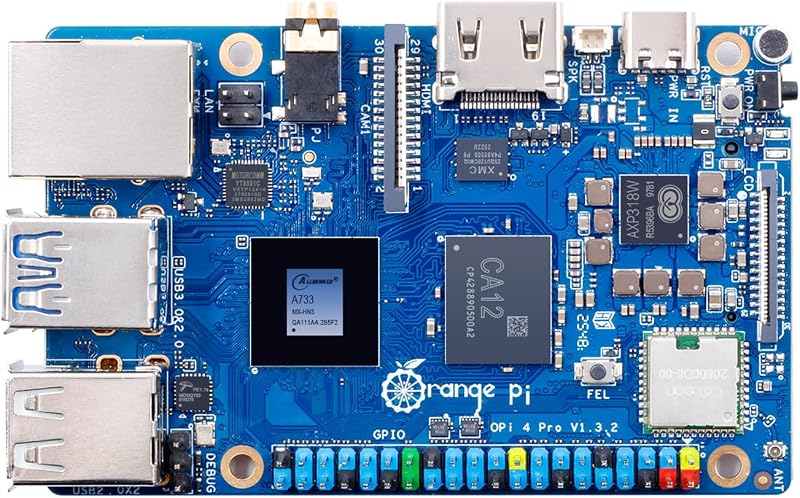
The Orange Pi 4 Pro 4GB provides an 8-core 64-bit architecture running at 2.0GHz alongside 4GB of LPDDR5 memory, an integrated 3TOPS neural processing unit, Wi-Fi 6, and Bluetooth 5.4. It supports Android, Linux, and Orange Pi OS out of the box as a mini PC. Builders who need built-in hardware acceleration for artificial intelligence or standard desktop input-output ports will prefer it over a bare system-on-module format.
Raspberry Pi 5 4GB Kit

The Raspberry Pi 5 4GB Kit includes a full-sized Raspberry Pi 5 single-board computer with 4GB of RAM, an active cooler, and an ABS protective enclosure. It delivers the same underlying processor architecture as the Compute Module 5 but carries standard full-sized ports, including dual display outputs and standard USB headers. Hobbyists, educators, and makers who want out-of-the-box hardware for robotics, retro gaming, or learning should choose this complete starter kit instead of an embedded module.
Final Verdict
The Raspberry Pi Compute Module 5 represents a substantial evolutionary step for embedded developers who demand the computational power of modern Cortex-A76 cores within a compact, modular footprint. By integrating 8GB of DDR4 memory, 32GB of robust eMMC flash, an onboard Gigabit PHY, and PCIe Gen 2 connectivity, this board-to-board module solves the mechanical and storage limitations often encountered when adapting standard single-board computers for industrial deployments.
While casual tinkerers will find the lack of native ports an insurmountable barrier, commercial designers and experienced makers will appreciate the engineering freedom it delivers. Combined with the included heatsink and external antenna kit, this hardware package offers a thoroughly capable, reliable foundation for next-generation edge devices, industrial controllers, and custom embedded machinery.
FAQ
Does the Raspberry Pi Compute Module 5 work without a carrier board?
No, the module utilizes high-density board-to-board connectors rather than standard USB, power, or video jacks. It requires a compatible baseboard or custom carrier board to supply power and access input and output interfaces.
Can I use this module on baseboards designed for the Compute Module 4?
Yes, the product listing highlights that the board-to-board connectors are most compatible with Compute Module 4 carrier hardware, allowing integrators to reuse existing baseboard designs with minimal mechanical friction.
What items come included in this specific bundle?
This package includes three primary items: the official Raspberry Pi CM5108032 module with 8GB RAM, 32GB eMMC flash, and wireless support, along with a dedicated heatsink and an external antenna kit.
What operating system does this hardware run?
The hardware is built to run Linux operating system distributions optimized for the platform architecture, making it compatible with server, personal computer, and industrial IoT environments.
How does the onboard eMMC storage benefit embedded projects?
Onboard eMMC storage is soldered directly onto the printed circuit board, providing enhanced physical reliability, shock resistance, and steady read-write performance up to 200 Mbps without the corruption risks common to removable micro-SD cards.