
As Amazon Associates, we earn from qualifying purchases. This means we may receive a small commission at no extra cost to you if you click through and make a purchase.
The Orange Pi CM5 is a high-performance system-on-module designed to deliver desktop-class computing capabilities in an ultra-compact footprint for deeply embedded systems. Built around the octa-core Rockchip RK3588S processor with 4GB of LPDDR4 memory and 32GB of onboard eMMC flash storage, this compute module packs massive processing power and high-speed input-output routing into a micro form factor, offering exceptional value for custom embedded designs despite requiring an external carrier board to expose its connections.
This core board suits embedded hardware engineers, industrial system designers, and robotics builders who need serious computing muscle, multi-camera input, and neural processing in space-constrained enclosures. Hobbyists, casual makers, and beginners looking for an out-of-the-box microcomputer with built-in standard HDMI and USB ports will find the integration overhead too complex and should look toward standard desktop single-board computers instead.


Orange Pi CM5 at a Glance

| Feature | Specification |
|---|---|
| System on Chip (SoC) | Rockchip RK3588S (8nm LP process) |
| CPU Configuration | 8-core 64-bit (4x Cortex-A76 at 2.4GHz and 4x Cortex-A55 at 1.8GHz) |
| Graphics Processor (GPU) | ARM Mali-G610 3D GPU (OpenGL ES 1.1/2.0/3.2, OpenCL 2.2, Vulkan 1.2) |
| Neural Processing Unit (NPU) | 6 TOPS AI accelerator supporting INT4, INT8, and INT16 hybrid modes |
| System Memory | 4GB LPDDR4 |
| Onboard Flash Storage | 32GB eMMC |
| Board-to-Board Interface | 3x 100-pin connectors (DF40C-100DP-0.4V(51)) |
| Display Output Support | HDMI 2.1 or eDP 1.3, DisplayPort 1.4 via Type-C, MIPI DSI |
| Supported Operating Systems | Android 12, Debian, Ubuntu, Linux |
| Power Requirements | DC 5V Max |
Processing Power and Neural Acceleration
At the center of the module sits the eight-core 64-bit Rockchip RK3588S system-on-chip, fabricated on an energy-efficient 8nm process. The processor architecture divides tasks across four high-performance ARM Cortex-A76 cores operating at up to 2.4GHz and four power-saving Cortex-A55 cores clocked at 1.8GHz. This big.LITTLE core arrangement gives the module the responsiveness needed to handle intense parallel computations without drawing unnecessary power during idle states. Developers relying on the orange pi cm5 rk3588s hardware foundation will appreciate the dedicated RK806-1 power management integrated circuit, which ensures stable power delivery across all eight execution cores during peak operating loads.
Visual processing and graphical workloads are handled by an integrated ARM Mali-G610 3D graphics unit that supports modern graphics APIs, including OpenGL ES 1.1, 2.0, and 3.2, OpenCL 2.2, and Vulkan 1.2. For specialized machine learning workloads, the orange pi cm5 ai npu provides up to 6 TOPS of dedicated neural acceleration with native support for INT4, INT8, and INT16 hybrid precision models. This integrated AI accelerator makes on-device inference practical for object detection, classification, and natural language tasks without bogging down the primary CPU cores, mirroring the computing capabilities found on full-sized boards such as the standard orange pi 5.
When evaluated under demanding operational workloads, the orange pi cm5 linux performance demonstrates strong multi-threaded execution speeds. Compiling complex software suites, processing continuous data streams, and running concurrent microservices proceed smoothly without the sluggish bottlenecking common to lower-tier development boards. The combination of 4GB LPDDR4 memory and 32GB onboard eMMC ensures that operating system operations, memory swapping, and intensive file caching maintain consistent throughput even when multiple services are executing simultaneously.
Carrier Interfacing and Expansion Versatility
Unlike conventional single-board computers that solder bulky Ethernet jacks, USB sockets, and video ports directly onto the circuit board, the Orange Pi CM5 relies on three high-density 100-pin board-to-board connectors utilizing the Hirose DF40C-100DP-0.4V(51) specification. This modular approach shrinks the footprint dramatically while routing a comprehensive suite of high-speed signals directly through the 300 total contact pins. Understanding the orange pi cm5 specs reveals that these headers break out PCIe 2.0, SATA III, USB 3.0, and three independent USB 2.0 channels, providing industrial hardware designers with unprecedented layout freedom.
To unlock the board’s full array of peripherals, builders connect the core module to the official orange pi cm5 base board or a custom application-specific motherboard. When docked with a carrier board, the module can drive multiple digital displays via HDMI 2.1 or eDP 1.3, DisplayPort 1.4 over Type-C, and high-density MIPI DSI display lanes. This architectural flexibility follows the design principles seen across the wider compute module 5 landscape, where separating the compute core from the input-output carrier simplifies future hardware upgrades and custom enclosure designs.
The board-to-board connector design provides distinct mechanical advantages in demanding operational environments. Traditional edge connectors or header pins can flex, loosen, or corrode over time when subjected to environmental vibration or mechanical shocks. The trio of 100-pin connectors provides a rigid, low-profile physical connection that distributes mechanical strain evenly across the carrier board. Additionally, hardware recovery and boot control lines, including POWER_ON, RESET, MASKROM, and RECOVERY, are accessible directly through the pinout, simplifying bench testing, automated flashing, and field servicing.
Industrial Automation and Robotics Deployment
The comprehensive sensor and camera interfaces make the orange pi cm5 for robotics and autonomous navigation a standout option in modern hardware builds. The module integrates an extensive collection of camera and display lanes, including one 4-lane MIPI DPHY TX, one 2-lane MIPI DPHY TX, two 2-lane MIPI DPHY RX interfaces, and a dedicated 4-lane MIPI CSI RX interface. This rich camera pipeline allows autonomous ground vehicles and robotic arms to ingest video feeds from multiple stereo camera pairs or computer vision sensors simultaneously without overwhelming external bus controllers.
Beyond camera pipelines, the module features robust low-level communication protocols essential for industrial machinery and embedded control. Hardware support for Controller Area Network (CAN) bus allows direct communication with automotive ECUs, robotic motor controllers, and factory sensors without needing intermediary bridge microcontrollers. Engineers can also tap into dedicated lines for UART, SPI, I2C, PWM, PDM, SPDIF, I2S, and general-purpose input-output (GPIO) pins, making it straightforward to read environmental sensors, control servo drivers, or sample audio signals in real time.
When evaluating whether the is orange pi cm5 worth it for industrial automation, the integrated storage and thermal form factor provide definitive advantages. The onboard 32GB eMMC storage module is far more resilient to sudden power outages, read-write cycles, and physical vibration than consumer microSD storage cards. Because the module concentrates its thermal generation across the RK3588S package in a compact physical zone, integrating custom thermal heat spreaders or mating the module directly to an aluminum chassis is far simpler than cooling a sprawling standalone development board.
Software Support and Operating System Ecosystem
Software versatility is a critical consideration for embedded hardware, and the Orange Pi compute module 5 supports multiple mature platforms straight out of the gate. The official documentation lists compatibility with Android 12, Debian, Ubuntu, and custom Linux distributions. Having access to full Debian and Ubuntu environments allows software engineers to deploy standard ARM64 containerized applications, Python automation scripts, and native C++ packages using the same development workflows they use on cloud or desktop Linux workstations.
The inclusion of 32GB eMMC flash memory significantly streamlines the operating system installation and maintenance lifecycle. The core board can be flashed directly via the onboard USB recovery interfaces using Rockchip development utilities, eliminating the need to burn and swap individual flash cards. Once flashed, the operating system boots rapidly from the eMMC bus, delivering reliable read and write performance during system updates, log recording, and heavy database transactions. The listing confirms that while the hardware architecture supports configurations up to 256GB eMMC, this specific Amazon package comes equipped with 32GB of eMMC storage.
Developers working on multimedia or graphical interface projects will appreciate the availability of an official Android 12 image. With hardware-accelerated 3D graphics and video decoding pipelines supported under Android, the board can serve as an embedded human-machine interface (HMI) for digital signage, medical carts, or point-of-sale kiosks. Users familiar with broader high-end Rockchip hardware, such as the orange pi 5 plus, will find familiar kernel distributions and Rockchip media processing library support, ensuring an easier path from proof-of-concept software to deployment.
Orange Pi CM5 Pros and Cons
Pros
- Octa-core Rockchip RK3588S processor running up to 2.4GHz
- Built-in 6 TOPS NPU for hybrid AI computing
- Onboard 32GB high-speed eMMC storage
- Three 100-pin connectors with PCIe and SATA support
- Runs Android 12, Debian, Ubuntu, and Linux
Cons
- Requires a compatible carrier board to access ports
- Only offered in a 32GB storage configuration on Amazon
- No onboard wireless radios specified on the core module
Who Should Buy the Orange Pi CM5
Buy It If
- You are an embedded systems engineer or commercial hardware developer building a custom carrier board for industrial equipment.
- You require high-performance local edge AI processing with a dedicated 6 TOPS NPU and multi-lane MIPI camera inputs.
- You need high-density board-to-board connectors with access to PCIe 2.0, SATA III, and multiple USB lines in a micro footprint.
- You prioritize reliable onboard 32GB eMMC flash storage over fragile, removable microSD cards for field deployments.
Skip It If
- You are looking for a standalone single-board computer with standard USB and HDMI ports that works straight out of the packaging.
- You are a casual maker or retro gaming hobbyist who wants ready-made community software images without carrier board setup.
- You require integrated wireless connectivity directly on the compute module without adding an external module to a carrier board.
Orange Pi CM5 Alternatives Worth a Look
Selecting the right processing board requires balancing raw performance against physical packaging, software ecosystems, and connectivity needs. Shoppers evaluating an orange pi cm5 vs raspberry pi or looking for alternative form factors should examine how these three distinct development boards match their specific engineering requirements.
Libre Computer Le Potato Mini

The Libre Computer Le Potato Mini is a traditional standalone single-board computer built in the classic maker board form factor, featuring 2GB of RAM, an included USB WiFi 4 dongle, and a cooling heatsink. It provides built-in standard HDMI, USB, and Ethernet ports directly on the board.
Makers should choose this board if they need a simple, self-contained development platform for basic Linux server utilities, light automation, or educational projects without needing to design or purchase a separate baseboard.
Raspberry Pi 5 4GB Kit

The Raspberry Pi 5 4GB Kit is an all-in-one standalone starter bundle featuring 4GB of RAM, an official active cooler, and a protective ABS case. It comes ready for immediate use with standard consumer ports, making it ideal for desktop experimentation, retro gaming, and educational IoT.
Shoppers who prioritize massive community documentation, ready-to-run third-party software images, and immediate out-of-the-box operation should pick this kit over an industrial compute module that requires custom carrier hardware.
Orange Pi 4 Pro 4GB
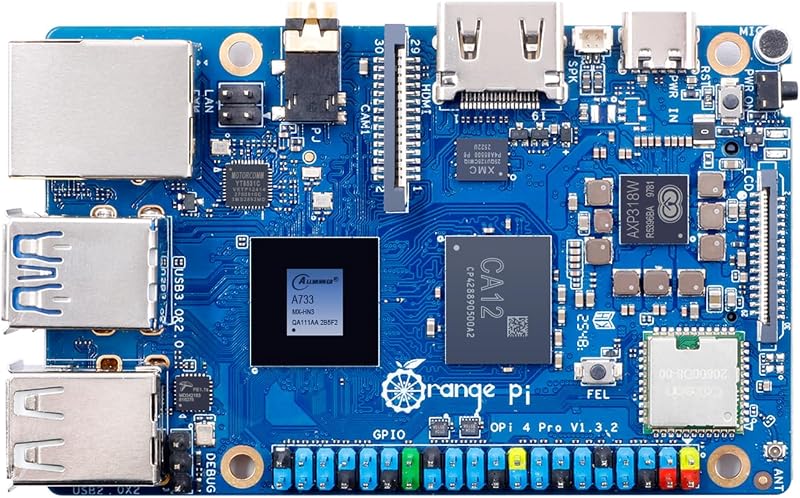
The Orange Pi 4 Pro 4GB is an 8-core 64-bit single-board computer powered by an Allwinner A733 processor running at 2.0GHz, featuring 4GB of LPDDR5 memory, an integrated 3 TOPS AI NPU, and built-in wireless networking with WiFi 6 and Bluetooth 5.4.
Builders who want an all-in-one mini PC style single-board computer running Android or Linux that already features integrated wireless networking and lower AI processing requirements will prefer this standalone board over the modular CM5.
Final Verdict
The Orange Pi CM5 represents an impressive feat of micro-engineering, packing the formidable processing performance of the octa-core Rockchip RK3588S SoC into a compact compute module. With its balanced pairing of Cortex-A76 and Cortex-A55 cores, 4GB of LPDDR4 memory, 32GB of reliable onboard eMMC storage, and an integrated 6 TOPS neural processor, it delivers desktop-grade computation and machine vision capabilities to custom embedded hardware designs.
Because it connects via three 100-pin high-density board-to-board headers, it is strictly intended for use alongside an official base board or a custom carrier PCB, making it unsuitable for beginners seeking a plug-and-play microcomputer. For commercial hardware designers, robotics engineers, and advanced embedded builders needing maximum computing density and versatile high-speed I/O in a tiny physical envelope, the Orange Pi CM5 is an exceptional foundation for next-generation hardware projects.
FAQ
Can the Orange Pi CM5 function as a standalone computer without an extra carrier board?
No, the Orange Pi CM5 is a compute core board that does not feature soldered external ports like full-sized USB, HDMI, or power jacks. It must be mounted onto the official Orange Pi CM5 base board or a custom-designed carrier board using its three 100-pin board-to-board connectors to access power and peripheral connections.
What operating systems can run on the Orange Pi CM5?
The product listing specifies support for Android 12, Debian, Ubuntu, and general Linux operating system builds compiled for the Rockchip RK3588S platform. Software images can be installed directly to the module’s internal storage.
Does the Orange Pi CM5 core board include built-in Wi-Fi and Bluetooth?
The product listing does not specify onboard Wi-Fi or Bluetooth radios directly on the core module. Wireless communication is typically added through carrier board expansion interfaces using SDIO, USB, or PCIe wireless modules.
What display outputs can be driven by the Orange Pi CM5?
The module routes multiple high-speed video outputs across its board-to-board connectors, including HDMI 2.1 or eDP 1.3, DisplayPort 1.4 via USB Type-C multiplexing, and MIPI DSI display interfaces for driving embedded panels.
Can the internal storage on this Orange Pi CM5 module be expanded?
This specific module comes equipped with 32GB of onboard eMMC flash storage. While the underlying hardware supports external SDMMC and SDIO 3.0 interfaces, physical microSD or NVMe expansion requires a carrier board that breaks out those storage buses.


