
As Amazon Associates, we earn from qualifying purchases. This means we may receive a small commission at no extra cost to you if you click through and make a purchase.
The Orange Pi 5 Plus is an expansive single board computer built around the high-performance Rockchip RK3588 processor, designed to bring desktop-class computing power and multi-gigabit throughput to DIY builders and system integrators. Equipped with eight processor cores, an integrated neural processing unit, and diverse physical inputs, this development platform moves far beyond the lightweight computing boundaries of traditional hobby boards. Whether configured as a responsive micro-workstation, an edge artificial intelligence appliance, or an ultra-dense media machine, it provides a comprehensive hardware base capable of tackling compute-heavy workloads.
This board is an ideal choice for advanced hobbyists, network administrators, and homelab experimenters who want to build a self-hosted appliance or miniature network bridge without running into processing bottlenecks. Builders transitioning from smaller boards like the standard orange pi 5 will appreciate the leap in connectivity and high-speed expansion slots. However, casual shoppers looking for a simple plug-and-play media streamer or novices who rely heavily on turnkey operating system images and massive beginner forums will face a steeper learning curve than they would with entry-level maker kits.


Orange Pi 5 Plus at a Glance

| Hardware Attribute | Specification Detail |
|---|---|
| Main Processor | Rockchip RK3588 (8nm LP process, 8 cores: 4x Cortex-A76 @ 2.4GHz + 4x Cortex-A55 @ 1.8GHz) |
| Graphics Hardware | ARM Mali-G610 3D GPU (OpenGL ES 1.1/2.0/3.2, OpenCL 2.2, Vulkan 1.2) |
| Neural Processing Unit | Embedded NPU with up to 6 TOPS computing power (INT4/INT8/INT16/FP16 hybrid operation) |
| System Memory | 8 GB LPDDR4 / LPDDR4x RAM |
| High-Speed Storage | M.2 2280 M-Key slot for NVMe SSDs (PCIe 3.0 x4, up to 2,000 MB/s) |
| Onboard Storage Options | MicroSD card slot (up to 128GB), eMMC socket (16GB to 256GB modules), 16MB/32MB QSPI Nor Flash |
| Ethernet Connectivity | Two PCIe extended 2.5G Ethernet RJ45 ports |
| Video Outputs | 2x HDMI 2.1 (up to 8K@60fps), 1x USB Type-C DisplayPort 1.4A (up to 8K@30fps), 1x MIPI DSI 4-Lane (up to 4K@60Hz) |
| Video Input | 1x HDMI input (up to 4K@60fps) |
| USB Connectivity | 2x USB 3.0, 2x USB 2.0, 1x Type-C interface |
| Operating System Support | Orange Pi OS, Ubuntu 22.04, Debian 11, Android 12 |
Processing Architecture and Edge AI Performance
At the center of the hardware layout is the high-efficiency Rockchip RK3588 system on a chip. When looking closely at the core orange pi 5 plus specs, the processor splits its workload across two distinct clusters: four performance-oriented ARM Cortex-A76 cores operating at up to 2.4GHz and four power-saving Cortex-A55 cores clocked at 1.8GHz. Built on a modern 8-nanometer process, this big.LITTLE architecture allows the board to maintain responsive performance under heavy multithreaded tasks while keeping idle thermal generation manageable during low-intensity operations.
Graphics tasks and machine learning pipelines benefit from substantial hardware acceleration. The integrated ARM Mali-G610 graphics processor delivers modern 3D rendering support for Vulkan 1.2, OpenCL 2.2, and OpenGL ES 3.2, which assists noticeably with desktop UI fluidity and graphical simulations. For advanced machine learning applications, the orange pi 5 plus rk3588 incorporates a dedicated neural processing unit capable of delivering up to 6 TOPS of compute. Because the NPU supports INT4, INT8, INT16, and FP16 hybrid operations, the board is thoroughly equipped to run local computer vision models, facial recognition engines, or automated edge telemetry without leaning on external cloud processing servers.
Memory handling on this particular model relies on 8GB of onboard LPDDR4 memory. Having the orange pi 5 plus 8gb configuration gives background applications sufficient headroom to breathe when running memory-hungry tasks such as containerized microservices or multiple web browser tabs. For embedded developers and homelab administrators who need a balance between cost and multitasking headroom, 8GB represents the practical sweet spot for this silicon platform.
Storage Bandwidth and Dual Multi-Gigabit Networking
A primary draw for home lab builders is the board’s comprehensive input-output layout, particularly regarding data transmission and localized disk speed. Moving an operating system away from slow memory cards is essential for system stability, and installing a fast orange pi 5 plus nvme ssd in the integrated M.2 2280 M-Key slot resolves traditional storage bottlenecks. Because this slot operates over a PCIe 3.0 x4 interface, it supports continuous read and write speeds reaching up to 2,000 MB/s. Builders can also take advantage of the onboard eMMC flash socket for modular onboard storage or utilize the MicroSD slot for rapid testing and operating system flashing.
Network connectivity is equally ambitious thanks to the presence of two dedicated 2.5-gigabit Ethernet interfaces. The orange pi 5 plus dual ethernet arrangement makes the board an ideal physical node for advanced networking configurations. Instead of sharing bus bandwidth across a single gigabit pipeline, the dual multi-gigabit controllers operate over dedicated PCIe extensions. This architectural choice prevents throughput starvation when shuttling high-bandwidth traffic between internal networks and internet modems.
These hardware features make setting up an orange pi 5 plus home server a compelling proposition. Whether you are running a lightweight virtualization hypervisor, managing network-attached storage pools, or deploying container suites, the combination of raw disk throughput and dual multi-gigabit lanes provides capabilities normally reserved for larger enterprise appliances. Homelab users looking to back up significant quantities of data over their local network can seamlessly pair this compact processing hub with dedicated mechanical storage arrays like a western digital red hard drive plugged into external storage enclosures.
Video Decoding, Display Connectivity, and Media Capabilities
Multimedia handling is another area where this single board computer distinguishes itself from low-power alternatives. The platform is engineered to decode video streams up to 8K resolution at 60 frames per second, making it an extraordinarily potent engine for driving digital signage or handling advanced home theater tasks. In an orange pi 5 plus media center deployment, the dual HDMI 2.1 output ports allow you to route ultra-high-definition video directly to modern television panels or desktop monitors with native audio pass-through support.
Beyond the primary HDMI ports, display versatility extends to a multifunctional USB Type-C port that supports DisplayPort 1.4A video transmission up to 8K at 30 frames per second, alongside an onboard 4-lane MIPI DSI display header. This allows users to establish multi-monitor configurations directly from the board without needing external video splitters. For interactive kiosks or specialized secondary monitoring arrays, this breadth of physical outputs provides exceptional deployment flexibility.
Unlike standard developer platforms that only focus on video output, this board includes a physical HDMI input port capable of ingesting video feeds up to 4K resolution at 60 frames per second. This turns the board into a viable capture appliance for video recording experiments, external camera passthrough setups, or machine vision development where an incoming video feed needs real-time analysis by the onboard Mali GPU or 6 TOPS neural processing unit.
Operating System Flexibility and Software Environment
Hardware strength is only as effective as the underlying platform drivers, and evaluating the orange pi 5 plus os support reveals a capable selection of Linux distributions and mobile operating systems. The manufacturer provides dedicated software images for Debian 11, Ubuntu 22.04, Android 12, and their custom-tailored Orange Pi OS. Because the RK3588 platform has matured steadily, users can choose between headless server distributions tailored for background automation or desktop environments built for daily office productivity.
Prospective buyers comparing the orange pi 5 plus vs raspberry pi 5 should note the different philosophical trade-offs between the two platforms. The Raspberry Pi ecosystem benefits from a massive community with decades of unified software development, making general driver setup almost invisible for beginners. In contrast, the Orange Pi platform offers significantly more expansive hardware—such as full-size NVMe M.2 2280 drive bays, dual 2.5GbE ports, and hardware 8K video pipelines—but it requires more comfort working with Linux terminals, configuring software repositories, and managing kernel modules.
For industrial deployments and specialized projects where form factor takes precedence, some builders look toward compute module standards such as the orange pi cm5 for custom carrier board integration. However, for users who desire all high-speed ports, multi-display connections, and networking jacks integrated natively onto a single ready-to-use board, this model eliminates the need for expensive daughterboards or proprietary carrier hardware.
Orange Pi 5 Plus Pros and Cons
Pros
- Powerful 8-core Rockchip RK3588 processor
- Dual 2.5GbE high-speed Ethernet ports
- Full-length M.2 2280 NVMe SSD expansion
- Integrated 6 TOPS edge AI neural unit
- Dual 8K HDMI outputs plus HDMI input
Cons
- No integrated onboard Wi-Fi or Bluetooth
- Requires separate cooling heatsink under heavy load
- Software configuration requires moderate Linux knowledge
Check Orange Pi 5 Plus on Amazon
Who Should Buy the Orange Pi 5 Plus
Choosing the right single board computer requires aligning your project requirements with the board’s specific strengths in networking, processing speed, and input connectivity.
Buy It If
- You want to build a high-performance network router, firewall, or multi-gigabit home server utilizing dual 2.5GbE ports.
- You need full-speed M.2 2280 PCIe 3.0 x4 solid-state storage without relying on external USB drive adapters.
- You are developing local artificial intelligence, edge computing, or computer vision projects that take advantage of a 6 TOPS NPU.
- You require rich display outputs supporting multi-screen 8K or 4K playback combined with an HDMI input port for capture workflows.
Skip It If
- You are an absolute beginner looking for simple plug-and-play documentation, beginner tutorials, and effortless out-of-the-box software.
- You require integrated wireless connectivity out of the box without purchasing an add-in M.2 E-Key module.
- Your projects only require simple sensor polling, basic micro-controller scripting, or low-intensity tasks that do not justify an 8-core processor.
Orange Pi 5 Plus Alternatives Worth a Look
If you are still evaluating your hardware requirements, several other developer boards and kits provide unique advantages depending on your budget, software expectations, and performance targets.
Libre Computer Le Potato Mini

The Libre Computer Le Potato Mini is a compact single board computer that comes packaged with 2GB of memory, a USB Wi-Fi 4 dongle, and a cooling heatsink. It is designed for lightweight Linux computing and introductory maker projects. While it lacks the multi-gigabit Ethernet, 8K video pipelines, and high-speed NVMe expansion found on the larger RK3588 platform, it serves as an accessible entry point for builders whose projects only demand basic server tasks or lightweight media streaming.
Raspberry Pi 5 4GB Kit

The Raspberry Pi 5 4GB Kit includes the 4GB variant of the single board computer alongside an active cooling fan and an ABS enclosure designed for robotics, retro gaming, and Internet of Things experiments. Shoppers who prioritize mainstream community tutorials, broad third-party accessory compatibility, and smooth out-of-the-box Linux desktop software will appreciate this starter bundle, even though it does not offer dual 2.5GbE networking or native full-length M.2 2280 mounting directly on the base board.
Orange Pi 4 Pro 4GB
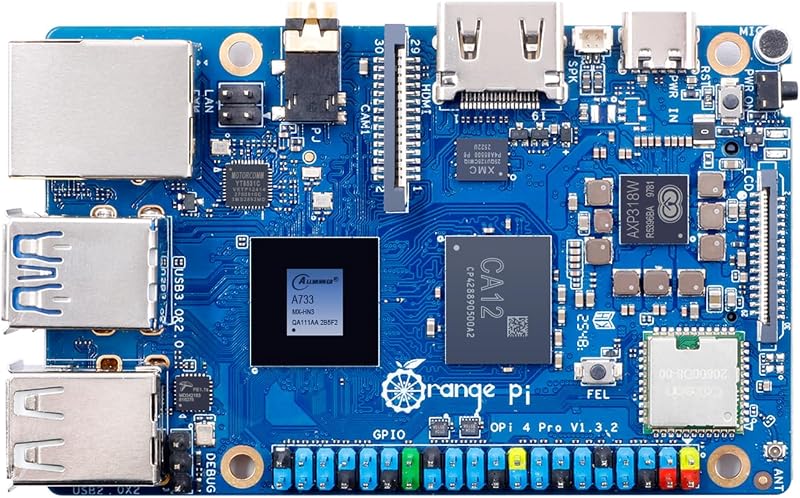
The Orange Pi 4 Pro 4GB is an 8-core 64-bit single board computer powered by the Allwinner A733 processor with 4GB of LPDDR5 memory, an integrated 3 TOPS neural processing unit, and modern Wi-Fi 6 and Bluetooth 5.4 wireless radios. It represents a practical middle ground for users who want built-in high-speed wireless connectivity and modern processing architecture without stepping up to the dual multi-gigabit Ethernet ports and larger physical footprint of the Plus series.
Final Verdict
When asking whether the hardware package of this board justifies investment, the answer hinges on how much you value raw throughput and versatile hardware interfaces. So, is orange pi 5 plus worth it? For users constructing custom networking gateways, self-hosted Docker clusters, or localized AI appliances, the combination of the Rockchip RK3588 processor, 8GB of system memory, dual 2.5GbE interfaces, and native M.2 NVMe storage makes it an outstanding performer in the single board category.
The primary compromise remains the software learning curve and the lack of built-in onboard wireless radios. If you are comfortable provisioning your own operating system images, obtaining an add-in wireless card if needed, and managing thermal dissipation under load, this board delivers unmatched expansion flexibility and processing speed that rivals miniature desktop computers.
FAQ
Does the Orange Pi 5 Plus have built-in Wi-Fi and Bluetooth?
The listing does not specify onboard wireless radios built directly into the PCB. Instead, the board features a dedicated M.2 E-Key expansion slot that allows users to install a compatible wireless card if Wi-Fi and Bluetooth connectivity are required for their build.
Can I boot an operating system directly from an NVMe SSD?
Yes, the hardware includes an onboard M.2 2280 M-Key slot wired to a PCIe 3.0 x4 interface along with onboard SPI flash memory. This setup enables users to flash and boot compatible operating system distributions directly from a high-speed solid-state drive without keeping a MicroSD card installed permanently.
What operating systems are officially supported on the board?
The manufacturer listing specifies support for Debian 11, Ubuntu 22.04, Android 12, and the official Orange Pi OS distribution. Community-built Linux distributions are also widely utilized by builders depending on their specific server or desktop requirements.
What display resolutions can the board output?
The board features dual HDMI 2.1 ports capable of outputting video resolutions up to 8K at 60 frames per second, a USB Type-C DisplayPort connection supporting up to 8K at 30 frames per second, and a 4-lane MIPI DSI connection supporting up to 4K at 60Hz.
Does the board include a power supply or case in the package?
The listing specifies a single unit count containing the Orange Pi 5 Plus 8GB single board computer itself. Enclosures, active cooling solutions, and dedicated USB Type-C power adapters must be sourced separately to complete your build.


