
As Amazon Associates, we earn from qualifying purchases. This means we may receive a small commission at no extra cost to you if you click through and make a purchase.
The Celestron StarSense Explorer LT 114AZ is a 114mm Newtonian reflector mounted on an altazimuth base that uses your smartphone camera and proprietary plate-solving software to guide you across the night sky. In a category long dominated by confusing paper star charts and finicky motorized alignment sequences, this telescope provides a refreshingly direct, intuitive path to locating planets, nebulae, and double stars within minutes of stepping outside.
This star sense telescope for beginners fits stargazers who want an active, guided introduction to backyard astronomy without spending hours memorizing constellations or troubleshooting complex motorized hand controllers. However, experienced observers who demand automated tracking for long-exposure photography or those who want an ultra-compact tabletop optical assembly should look toward dedicated motorized systems or compact tabletop alternatives instead.
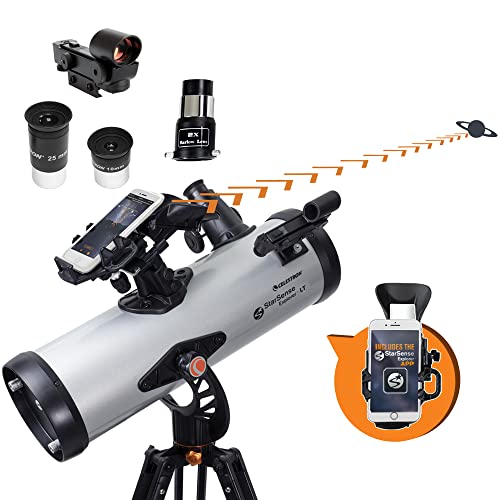


Celestron StarSense Explorer LT 114AZ at a Glance

| Feature | Specification |
|---|---|
| Optical Design | Newtonian Reflector |
| Aperture (Objective Diameter) | 114 mm (4.5 inches) |
| Focal Length | 1000 mm |
| Eyepieces Included | 25mm and 10mm |
| Mount Type | Manual Altazimuth (AZ) with slow-motion altitude adjustment |
| Finderscope | Reflex finderscope |
| Optical Coatings | Glass mirrors coated with aluminum and SiO₂ |
| Field of View | 2.04 degrees |
| Dawes Limit & Zoom Ratio | 1.02 arcseconds Dawes limit; 175 zoom ratio |
| Dimensions & Weight | 36 x 36 x 57 inches; 10.4 pounds |
StarSense Sky Recognition Technology and App Performance
The centerpiece of this smartphone guided telescope is Celestron’s patented StarSense sky recognition technology. Traditional astronomy apps rely purely on a phone’s internal compass and gyroscopes, which frequently drift, suffer from magnetic interference, and lack the precision needed to match an eyepiece view. The StarSense Explorer app bypasses that limitation entirely by using your phone camera to photograph star patterns overhead, matching them against an internal database via a Lost in Space Algorithm (LISA)—the exact same plate-solving method utilized by orbital satellites.
Operating the star sense telescope app is straightforward: you place your compatible smartphone into the specialized dock located atop the optical tube and run a brief daytime or dusk alignment. Once night falls, the app calculates precisely where the 24-inch optical tube is aimed in real time. As you manually push the telescope across the sky, on-screen guidance arrows steer you toward your target. When you center the object, the crosshairs lock on and a green bullseye illuminates, indicating that the celestial object is sitting right in the center of your eyepiece.
The application also removes the guesswork of deciding what to observe on any given evening. It automatically builds a curated “Tonight’s Best Targets” list tailored to your specific observing time, geographic coordinates, and local light pollution levels. In urban and suburban backyards, it prioritizes the Moon, bright planets, and resilient double stars. Under darker rural skies, the software unlocks a broader collection of deep-sky objects including nebulae and star clusters, giving beginners immediate direction without requiring previous sky-mapping experience.
Optical Performance and Visual Clarity
Underneath the digital phone guidance sits a traditional 114mm (4.5-inch) Newtonian reflector. In this Celestron StarSense Explorer LT 114AZ review, the optical assembly proves itself well-matched to beginner observational goals. The 114mm primary mirror collects substantially more light than entry-level 60mm or 70mm refractors, providing brighter, cleaner views of low-contrast targets. Celestron treats the glass mirrors with aluminum and silicon dioxide (SiO₂) coatings to maintain high reflectivity and preserve light throughput across the 1000mm focal length.
Through the eyepiece, the optical design yields clean, rewarding sights. Lunar observing reveals sharp contrast along the terminator line, displaying crisp details within crater walls, mountain peaks, and maria. Bright planets within our solar system show distinct structural features: Jupiter reveals its equatorial cloud bands and four Galilean moons, while Saturn displays its prominent ring system. When steered toward deep-sky favorites away from city lights, the 114mm aperture delivers discernible structure in targets like the Orion Nebula (M42) and the soft core of the Andromeda Galaxy (M31).
Celestron packages two standard eyepieces with the telescope: a 25mm lens for wide-field scanning and a 10mm lens for higher-magnification planetary observation. The system delivers a theoretical Dawes limit of 1.02 arcseconds, an exit pupil diameter of 5.7mm, and a wide 2.04-degree field of view with the lower-power eyepiece. While it does not match the deep light grasp of larger aperture instruments like the celestron nexstar 8se telescope, it provides crisp, chromatic-aberration-free viewing across its magnification range, making it a capable everyday reflector for solar system and bright deep-sky exploration.
Mount Stability and Manual Altitude Adjustment
The telescope rests on a full-height, manual altazimuth mount engineered for simple push-to navigation. Because this is not a motorized GoTo instrument, you supply the physical movement while following the app’s directional arrows. The mount features an altitude slow-motion adjustment rod with a sliding mechanism, allowing fine vertical repositioning once you get close to your intended celestial object. Azimuth (side-to-side) panning operates on a tensioned manual friction axis.
The total assembled weight comes in at 10.4 pounds, making it easy to carry into the yard in a single trip. The aluminum tripod provides an adjustable working height with a full footprint of 36 inches deep by 36 inches wide and up to 57 inches high. For observers familiar with grab-and-go refractors like the celestron omni az 102, this altazimuth base offers familiar manual panning freedom without the mechanical complexity or battery demands of motorized gears.
Because Earth’s rotation causes celestial objects to drift out of view, observing at high magnification requires periodic manual adjustment. The altitude slow-motion rod makes nudging the tube upward or downward smooth, though horizontal re-centering requires a gentle push on the mount head. The 10.4-pound total weight keeps the assembly portable, but like any lightweight tripod system, touching the focuser or nudging the tube introduces slight vibrations that settle after a few seconds.
Setup Process and Everyday Usability
The StarSense Explorer setup workflow is designed specifically to eliminate traditional beginner stumbling blocks. Assembling the optical tube, tripod, and accessory tray requires no tools and takes roughly fifteen minutes out of the box. Once the mechanical assembly is complete, you install the included reflex finderscope, which runs on an included lithium metal battery, to assist with manual sighting whenever you choose not to dock your phone.
Aligning the phone dock to the telescope optics is the only critical preparation step, and it is best completed during daylight or twilight. You center a distant land object—such as a street sign or distant tree branch—in the 25mm eyepiece, clamp your smartphone into the spring-loaded dock, and use the StarSense app’s alignment screen to match the crosshairs to the same landmark. This mechanical-to-camera alignment takes under two minutes and remains calibrated throughout your evening observing session.
At 24 inches long for the optical tube and just over ten pounds for the entire rig, storage and transport are hassle-free. It fits easily into car trunks or backseats for trips to dark-sky parks. Celestron backs the telescope with a 2-year US warranty and unlimited customer support from their US-based technical staff, offering long-term peace of mind for those stepping into the hobby for the first time.
Celestron StarSense Explorer LT 114AZ Pros and Cons
Pros
- Patented StarSense sky recognition guides you directly to targets
- Generous 114mm aperture provides crisp views of planets and nebulae
- Curated app list shows the best targets visible tonight
- Lightweight 10.4-pound design moves easily into the backyard
- Includes two eyepieces and an altitude slow-motion adjustment rod
Cons
- Manual altazimuth mount requires hand tracking as targets drift
- Lightweight tripod can show vibrations when adjusting focus
- Open reflector design occasionally requires secondary mirror alignment
Check Celestron StarSense Explorer LT 114AZ on Amazon
Who Should Buy the Celestron StarSense Explorer LT 114AZ
Buy It If
- You want a smartphone-guided experience that teaches you how to locate objects without relying on inaccurate phone compasses
- You prefer a lightweight, 10.4-pound telescope that can be moved into the backyard in one piece
- You want clear, color-pure views of the Moon, Saturn’s rings, Jupiter’s moons, and bright deep-sky targets through a 114mm reflector
- You want a curated viewing experience that highlights the best available sky targets based on your exact time and location
Skip It If
- You require motorized tracking to keep targets centered automatically without manual hand adjustments
- You want an ultra-compact, pre-assembled tabletop design such as the celestron firstscope telescope for small balconies or camping tables
- You intend to pursue deep-space astrophotography requiring long motorized exposures and heavy camera attachments
Celestron StarSense Explorer LT 114AZ Alternatives Worth a Look
If your observing priorities tilt toward smaller optical tubes, tabletop form factors, or different beginner packages, several alternative telescopes cater to different viewing spaces and budgets.
Gskyer Telescope

The Gskyer Telescope features a 70mm aperture refractor design paired with a 400mm focal length, an altazimuth mount, a dedicated carry bag, a phone adapter, and a wireless remote. It serves as a travel-oriented alternative for users who want an enclosed glass lens system rather than an open reflector mirror, making it well suited for younger kids or frequent road trips where rugged portability is the top priority.
NASA Lunar Telescope
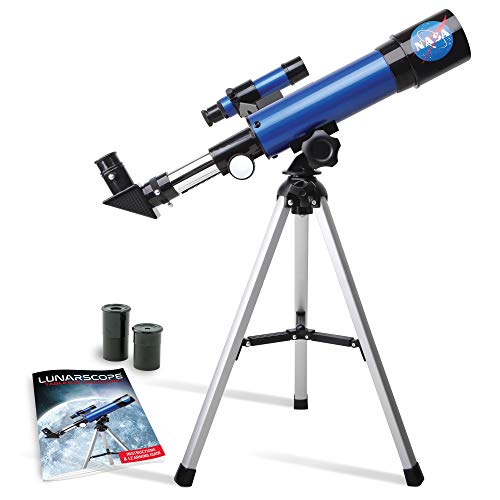
The 90x Magnification telescope is an entry-level astronomy kit designed for kids ages 8 to 12. It includes a tabletop tripod, two eyepieces providing up to 90x magnification, and a finder scope. This option is tailored specifically as a space-themed gift or desktop introduction to the Moon, appealing to families seeking a simplified tabletop setup rather than a full-height tripod assembly.

UncleHu High Powered Refractor Telescope
The High Powered telescope by UncleHu provides a 90mm aperture refractor with a 500mm focal length, a faceted tube, an adjustable tripod, a phone adapter, a backpack, and an included moon filter. It is an appealing option for adult beginners who prefer a complete grab-and-go backpack kit built around a refractor optical tube rather than a Newtonian reflector layout.

Final Verdict
The Celestron StarSense Explorer LT 114AZ stands out as one of the most practical innovations in entry-level stargazing. Instead of forcing beginners to master complex equatorial mounts, navigate inaccurate compass sensors, or memorize faint star charts, it harnesses the camera technology already in your pocket. The plate-solving algorithm brings genuine ease of use to sky navigation, ensuring that evening observing sessions are spent looking through the eyepiece rather than hunting blindly across the dark.
When asking if the star sense telescope is worth it, the answer comes down to whether you value time spent viewing over time spent searching. Combining a capable 114mm optical tube, glass mirrors coated with aluminum and silicon dioxide, and reliable real-time smartphone guidance, this telescope eliminates the steepest hurdle in backyard astronomy. For anyone seeking a practical, user-friendly gateway to the planets and bright deep-sky wonders, it delivers exceptional navigational confidence.
FAQ
How does the StarSense Explorer app know where the telescope is pointed?
The app uses patented sky recognition technology and a Lost in Space Algorithm (LISA) to analyze overhead star patterns photographed by your smartphone camera. By comparing those patterns against an onboard database, it calculates the telescope’s precise orientation in real time without relying on inaccurate internal phone compasses.
Can I use the Celestron StarSense Explorer LT 114AZ without a smartphone?
Yes. The telescope functions as a completely standard manual 114mm Newtonian reflector. Celestron includes a battery-powered reflex finderscope, allowing you to locate and sight targets manually using conventional sky charts or visual landmarks whenever you do not want to use your phone.
What celestial objects can I see with the 114mm reflector?
The 114mm aperture with aluminum and SiO₂ coated mirrors delivers sharp, bright views of the Moon’s craters and mountain ranges, Jupiter and its four largest moons, the rings of Saturn, and bright deep-sky favorites including the Orion Nebula, Andromeda Galaxy, and various star clusters from dark sky locations.
Does the telescope require batteries to operate?
The optical tube and altazimuth mount operate entirely manually and require no power. The only battery required by the system is one lithium metal battery, which is included in the package to power the red reflex finderscope.
How difficult is the initial StarSense alignment process?
The setup is quick and straightforward. During the daytime or at dusk, you point the telescope at a recognizable distant object, center it in the eyepiece, dock your phone, and adjust the app’s crosshairs to match the view. Once aligned, the phone remains synchronized with the telescope for the rest of the night.


