
As Amazon Associates, we earn from qualifying purchases. This means we may receive a small commission at no extra cost to you if you click through and make a purchase.
The MSI MPG X670E Carbon WiFi is a high-end ATX motherboard engineered around AMD’s AM5 socket, built to anchor high-performance desktop configurations running Ryzen 7000, 8000, and 9000 series processors. Serving as an enthusiast-grade entry in MSI’s performance gaming lineup, it combines cutting-edge PCIe 5.0 bandwidth with extensive power cooling and multi-generational processor compatibility. Our straight verdict is clear: this motherboard provides rock-solid electrical stability and exceptional expandability for heavy multi-taskers and hardware enthusiasts, but its high-end feature set offers far more bandwidth and hardware redundancy than a standard gaming build will ever actually leverage.
This motherboard suits PC builders seeking a premium AM5 platform with robust heat dissipation, multiple Gen 5 storage options, and plenty of rear connectivity for demanding workloads or enthusiast overclocking. If you plan to pair a top-tier processor with several high-speed drives and need premium power delivery cooling to manage sustained loads, it forms a dependable backbone. Conversely, everyday gamers who simply want high frame rates without juggling complex PCIe lane configurations or extreme memory tuning will be far better served by a more focused, mainstream board such as the msi mag b650 tomahawk, which delivers core gaming performance without the extra structural overhead.


MSI MPG X670E Carbon WiFi at a Glance
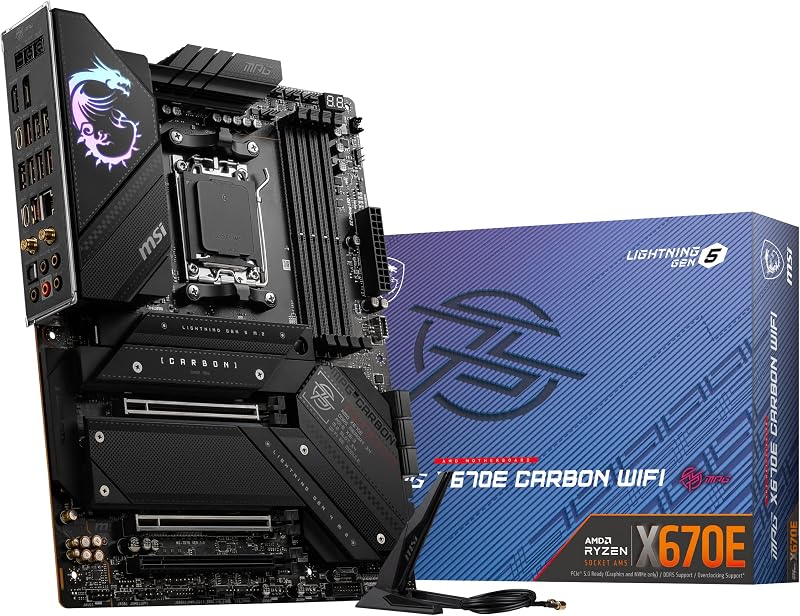
| Feature | Specification Details |
|---|---|
| CPU Socket | Socket AM5 |
| Chipset | AMD X670 |
| Supported Processors | AMD Ryzen 9000, 8000, and 7000 Series Desktop Processors |
| Memory Architecture | 4 DIMM Slots, Dual Channel DDR5 (Up to 6600 MHz / DDR5-5600+ OC) |
| Primary Expansion | PCIe 5.0 Expansion Slots |
| Storage Interfaces | Lightning Gen 5 x4 M.2 Connectors and SATA 6Gb/s Ports |
| Thermal Features | Aluminum Cover, Heat-Pipe, 7W/mK MOSFET Pads, M.2 Shield Frozr |
| Wireless Networking | Wi-Fi 6E and Bluetooth 5.3 |
| Wired Networking | 2.5Gbps LAN |
| Form Factor | ATX |
Thermal Design and Power Delivery Cooling
A flagship motherboard requires serious thermal management to maintain peak performance during extended workloads, and the mpg x670e carbon thermal design takes cooling very seriously. The board incorporates an extended aluminum I/O cover connected via an integrated heat-pipe to distribute thermal energy across multiple heatsink blocks. Direct contact with critical voltage regulator components is managed through high-grade MOSFET thermal pads rated at 7W/mK, backed by additional choke thermal pads. This heavy-duty metal structure prevents localized hot spots from forming when high-wattage desktop processors operate under demanding multithreaded renders or sustained high-stress computing tasks.
Storage components also generate significant heat, especially as drive speeds increase across modern interface generations. MSI equips this board with double-sided M.2 Shield Frozr heatsinks across the primary drive positions, shielding sensitive NVMe solid-state drives from thermal throttling under heavy read and write routines. Keeping storage controllers beneath their maximum operating temperature prevents abrupt throughput degradation during large file transfers or uninterrupted gaming installations. For builders familiar with sleeker mainstream alternatives like the msi mpg b650 edge wifi, the Carbon variant delivers a noticeably heavier, more dense heatsink array designed specifically to absorb thermal spikes from multi-core power draws.
The practical result for everyday builders is passive reliability. The board relies on dense finned metal rather than tiny active cooling fans on the chipset or VRM blocks, reducing noise levels and eliminating moving parts that could fail over time. Proper case airflow easily sweeps heat away from the massive aluminum structures, ensuring that VRM temperatures stay low even when pushing AMD Ryzen multi-core chips to their factory power limits.
PCIe 5.0 Lanes and High-Speed Storage Expansion
One of the strongest technical arguments for choosing an X670E chipset is expansive bandwidth allocation, and the msi x670e carbon pcie 5.0 lanes give users substantial connectivity runway. The board implements PCIe 5.0 signaling across its primary graphics slot as well as dedicated Lightning Gen 5 x4 M.2 storage connections. This ensures double the theoretical throughput over the prior Gen 4 standard, establishing compatibility with next-generation add-in cards and ultra-fast solid-state drives without bandwidth starvation.
Alongside its Gen 5 connections, the msi x670e carbon am5 motherboard retains backwards compatibility with conventional storage interfaces through integrated SATA 6Gb/s ports and supplementary M.2 interfaces. This enables builders to migrate legacy solid-state or mechanical drives into a modern build alongside bleeding-edge boot volumes. Whether you are assembling a creative workstation handling uncompressed video assets or an expansive gaming library spanning several terabytes, the physical layout supports deep storage arrangements without requiring auxiliary expansion cards.
However, users must evaluate whether their hardware ecosystem actually demands Gen 5 speeds. Current discrete graphics cards rarely saturate Gen 4 connections, meaning the primary gaming benefit of PCIe 5.0 remains largely forward-looking rather than an immediate boost to gaming frame rates. If your build pairs a standard graphics card with reliable Gen 4 NVMe drives, the extensive PCIe 5.0 routing on this board represents technical headroom rather than a performance increase you will feel in day-to-day gameplay.
Memory Speed and DDR5 Overclocking Potential
Transitioning to socket AM5 requires an exclusive commitment to DDR5 system memory, and the mpg x670e carbon ddr5 support is engineered to handle fast memory profiles. The motherboard features four DIMM slots configured for dual-channel operation, with the official listing detailing memory clock speed support reaching 6600 MHz and factory validated for DDR5-5600+ overclocked kits. This provides enthusiast builders with the flexibility to fine-tune memory timings, sub-timings, and clock rates to extract maximum processing throughput from their Ryzen memory controllers.
Maintaining signal purity at high memory clock speeds requires a clean motherboard trace layout, which MSI supports through isolated memory circuitry. While AM5 memory stability generally reaches its sweet spot when operating two high-speed modules rather than filling all four slots, having four available DIMMs ensures that users who prioritize total memory capacity over raw speed can populate all channels. Builders aiming to assemble high-capacity configurations for video editing or local database development can install maximum memory density to satisfy resource-heavy professional tasks.
For gamers, the performance impact of ultra-fast memory speeds tends to show diminishing returns past common high-speed standards. Ensuring your DDR5 kit aligns with AMD memory frequency optimizations delivers noticeably snappier frame-time pacing, but chasing high frequencies up toward 6600 MHz demands careful tuning and validation. The board provides the underlying electrical hardware to pursue those speeds, but everyday users will likely prefer enabling standard memory profiles and letting automated timings handle system stability.
Connectivity, Networking, and Mystic Light Aesthetic
Rear panel and internal connectivity heavily influence how convenient a motherboard is to live with, and the msi mpg x670e carbon wifi specs include modern peripheral and networking protocols. The rear I/O incorporates USB 3.2 Gen 2 ports alongside display outputs including HDMI and DisplayPort for processors equipped with integrated graphics. Networking covers both wired and wireless preferences: an onboard 2.5Gbps LAN controller provides low-latency wired networking for local file transfers and competitive matches, while integrated Wi-Fi 6E and Bluetooth 5.3 handle high-bandwidth wireless connections and peripheral pairing.
For builders who care about chassis presentation, the board integrates MSI Mystic Light technology. The onboard lighting ecosystem supports 16.8 million colors across 29 distinct illumination effects that can be adjusted through software. Furthermore, dedicated Mystic Light Extension headers allow builders to synchronize both standard RGB and addressable Rainbow LED strips directly through the motherboard, eliminating the need for bulky external RGB controller hubs.
The physical aesthetic of the Carbon series remains industrial and stealthy, utilizing matte black heatsinks with subtle carbon fiber accents beneath the customizable illumination. This makes it easy to integrate the motherboard into diverse build themes, whether you want an understated dark aesthetic inside a tinted glass enclosure or a fully synchronized color display. The balance between visual flair and physical port layout makes it well suited for modern desk setups requiring multiple peripherals.
Real-World Gaming Performance and Platform Value
When assessing whether to choose the msi mpg x670e carbon wifi for gaming, it is essential to understand the functional role of the motherboard. Motherboards do not directly render graphical frames or calculate physics engines; instead, they serve as the foundational highway supplying clean power, maintaining low temperatures, and ensuring bottleneck-free communication between the CPU, GPU, and memory. In pure gaming scenarios, a processor running on this motherboard will deliver identical in-game frame rates to the same processor running on an alternative AM5 board, assuming power delivery and thermal conditions remain within spec.
The true platform value of this board lies in its operational margins and expandability. For players who stream their gameplay while encoding background video, managing multiple capture cards, and routing numerous high-speed USB audio interfaces, the multi-lane bandwidth of the X670E chipset prevents device dropouts. Builders evaluating next-generation alternatives like the msi x870e tomahawk will find that the Carbon holds its ground with heavy-duty construction and versatile I/O, even as newer chipset refreshes enter the enthusiast arena.
Ultimately, answering whether this board aligns with your gaming goals comes down to hardware scaling. If your PC configuration centers on a single graphics card and a couple of gaming drives, the extensive secondary expansion slots and heavy multi-lane chipset architecture remain underutilized. It represents an investment in platform longevity and high-power stability rather than an immediate boost in gaming frame rates.
MSI MPG X670E Carbon WiFi Pros and Cons
Pros
- PCIe 5.0 slots and Lightning Gen 5 M.2
- DDR5 support up to 6600 MHz
- Heavy thermal solution with 7W/mK MOSFET pads
- Fast Wi-Fi 6E and 2.5Gbps LAN
- Broad AMD Ryzen 9000, 8000, and 7000 support
Cons
- PCIe 5.0 bandwidth exceeds standard gaming needs
- Heavy multi-chipset design adds build complexity
- Higher power requirements than mainstream B-series boards
Check MSI MPG X670E Carbon WiFi on Amazon
Who Should Buy the MSI MPG X670E Carbon WiFi
Buy It If
- You are assembling a high-end AMD AM5 system with Ryzen 7000, 8000, or 9000 series desktop processors under sustained compute loads.
- You plan to take full advantage of multiple PCIe 5.0 expansion slots and high-speed Lightning Gen 5 M.2 solid-state storage.
- You want a heavy-duty thermal solution with 7W/mK MOSFET pads, heat-pipes, and full M.2 Shield Frozr coverage for passive cooling.
- You need high-bandwidth networking options including 2.5Gbps LAN, Wi-Fi 6E, and Bluetooth 5.3 for gaming and local network transfers.
Skip It If
- You are building a standard mid-range gaming PC that only utilizes one graphics card and a single standard NVMe storage drive.
- You do not plan to utilize PCIe 5.0 storage speeds or extreme DDR5 memory clock speeds past factory baselines.
- You prefer a minimalist motherboard that eliminates extra multi-lane chipset hardware to keep system complexity low.
MSI MPG X670E Carbon WiFi Alternatives Worth a Look
Before locking in your motherboard choice, it helps to examine other platforms and chipset alternatives to determine which hardware best matches your specific computing requirements and processor family.
GIGABYTE B850 AORUS Elite WIFI7

The GIGABYTE B850 AORUS Elite WIFI7 is an AMD AM5 ATX motherboard designed to support AMD Ryzen 9000, 8000, and 7000 series processors. It features a 14+2+2 power phase design, three M.2 slots, PCIe 5.0 support, USB-C, 2.5GbE LAN, EZ-Latch hardware installation features, and upgraded WIFI7 wireless networking backed by a 5-year warranty. Shoppers should pick this alternative over the Carbon if they want newer WIFI7 connectivity and user-friendly latching mechanisms on a modern B850 chipset without needing the dual-chipset complexity of X670E.
Asus ROG Strix B550-F Gaming

The Asus ROG Strix B550-F Gaming is an AMD AM4 ATX gaming motherboard built for 3rd Gen Ryzen processors, utilizing DDR4 memory architecture instead of DDR5. It provides PCIe 4.0 expansion, WiFi 6E, 2.5Gb LAN, BIOS Flashback, HDMI 2.1 display output, and Addressable Gen 2 RGB headers with Aura Sync. This board is the ideal choice for builders who already own DDR4 memory or want a dependable AM4 build rather than investing in a brand-new AM5 processor and DDR5 platform.
paired with Asrock Z890 PRO

The paired with Asrock Z890 PRO bundle combines an Asrock Z890 PRO RS WiFi ATX motherboard with an Intel Core Ultra 5 250K Plus processor featuring 18 cores reaching up to 5.3 GHz and 30MB cache. The platform includes WiFi 6E, PCIe 5.0 support, and a fast 20Gbps Type-C connection. Builders should pick this package over the MSI Carbon if they prefer migrating to Intel’s latest Core Ultra desktop platform with an included high-core CPU rather than building around an AMD AM5 socket.
Final Verdict
In this msi mpg x670e carbon wifi review, the motherboard establishes itself as an uncompromised enthusiast board designed for builders who refuse to cut corners on connectivity, thermal mass, or component expansion. Its robust cooling infrastructure—anchored by thick aluminum heatsinks, heat-pipe distribution, and 7W/mK thermal pads—guarantees that even high-draw Ryzen processors can operate at their full potential without thermal throttling at the power delivery stage. With native support for dual-channel DDR5 up to 6600 MHz, cutting-edge PCIe 5.0 signaling, and dual wired and wireless networking solutions, the technical capabilities are hard to dispute.
However, whether is msi mpg x670e carbon wifi worth it ultimately depends on your hardware ambition. For an everyday gamer running a mid-tier CPU and standard graphics card, much of the board’s high-speed lane capacity and thermal headroom will sit idle. But if you demand a top-tier platform capable of housing multiple Gen 5 drives, rigorous memory overclocking, and heavy workstation loads, the Carbon delivers the uncompromising structural stability needed to anchor an exceptional desktop build.
FAQ
Does the MSI MPG X670E Carbon WiFi support AMD Ryzen 9000 series processors?
Yes, the motherboard is built on socket AM5 and supports AMD Ryzen 9000, 8000, and 7000 series desktop processors, offering forward compatibility across multiple generations of AMD chips.
What memory speeds does the MPG X670E Carbon DDR5 support reach?
The board supports 4 DIMM slots running dual-channel DDR5 memory with official specifications supporting DDR5-5600+ (OC) and memory clock speeds reaching up to 6600 MHz.
Does this motherboard feature PCIe 5.0 expansion?
Yes, the board includes PCIe 5.0 expansion slots as well as dedicated Lightning Gen 5 x4 M.2 storage connectivity to support next-generation graphics cards and ultra-fast solid-state drives.
What networking options are built into the MSI MPG X670E Carbon WiFi?
The motherboard includes high-speed 2.5Gbps LAN for low-latency wired connections, along with integrated Wi-Fi 6E and Bluetooth 5.3 for wireless networking and peripheral connectivity.
Can you connect external lighting to the Mystic Light system?
Yes, the motherboard features Mystic Light Extension headers that support both standard RGB and addressable Rainbow LED strips, allowing centralized illumination control across 29 effects and 16.8 million colors.
Does the motherboard come with integrated heat dissipation for M.2 drives?
Yes, it features M.2 Shield Frozr heatsinks designed to cool installed M.2 solid-state drives directly, preventing thermal throttling during continuous read and write operations.


