
As Amazon Associates, we earn from qualifying purchases. This means we may receive a small commission at no extra cost to you if you click through and make a purchase.
The ASUS TUF RTX 5070 is a heavy-duty graphics card designed around NVIDIA’s Blackwell architecture, pairing high-speed GDDR7 memory with an oversized industrial cooling assembly. Engineered as an overclocked model featuring dual operating profiles up to a 2640 MHz boost clock, this unit focuses entirely on low operating temperatures, physical reinforcement, and long-term hardware endurance. For everyday desktop builders who want stable high-resolution gaming without worrying about thermal throttling or component degradation, it presents an uncompromising, utility-focused package.
This graphics card directly suits dedicated PC gamers and content creators running standard mid-tower or full-tower chassis who value ultra-quiet acoustics, structural durability, and extensive display connectivity. However, builders attempting compact mini-ITX assemblies, systems with tight expansion slot clearances, or setups constrained by narrow case depths should look toward smaller dual-slot cards, as the physical footprint of this card requires substantial breathing room.


ASUS TUF RTX 5070 at a Glance

| Attribute | Detail |
|---|---|
| Graphics Processor | NVIDIA GeForce RTX 5070 |
| Architecture | NVIDIA Blackwell |
| Video Memory | 12 GB GDDR7 |
| Clock Speeds | OC Mode: 2640 MHz / Default Mode: 2610 MHz |
| Memory Clock | 2640 MHz |
| Physical Dimensions | 13 inches (L) x 5.5 inches (W) |
| Slot Profile | 3.125-slot design |
| Thermal Design | Phase-change GPU pad, 3 Axial-tech fans, massive fin array |
| Video Outputs | 3x DisplayPort 2.1a, 2x HDMI 2.1b |
| Maximum Resolution | 7680×4320 pixels |
Cooling Architecture and Heatsink Engineering
The core attraction of this model lies in the thermal assembly that ASUS has engineered over the GPU die. At the foundation of the rtx 5070 tuf cooling array is a custom phase-change GPU thermal pad rather than traditional thermal paste. Standard thermal compounds can suffer from pump-out effects and drying over extended periods of repeated heating and cooling cycles. The solid-to-liquid transition of a phase-change pad maintains consistent surface contact between the silicon and copper heat spreader under high thermal loads, helping ensure long-term thermal conductance without requiring routine maintenance.
Dissipating heat away from the core requires significant volume, which ASUS achieves through a thick heatsink structure that expands the card into a 3.125-slot footprint. The dense fin stack is ventilated by three Axial-tech fans configured to optimize downward air pressure while minimizing turbulence. This airflow configuration drives fresh air completely through the fin channels, exhausting heat out through the backplate cutouts and the chassis rear vents. For demanding gaming workloads, this means lower operating temperatures and reduced fan acoustic levels compared to slimmer reference enclosures.
Thermal control extends into software customization via GPU Tweak III. Users can actively monitor temperatures, adjust custom fan curves, and toggle between factory-set operating profiles directly within the interface. Whether prioritizing dead-silent desktop operation during light office productivity or ramping up airflow to sustain a continuous 2640 MHz clock during heavy rendering, the cooling hardware provides ample thermal headroom to prevent performance drops caused by heat saturation.
Build Quality, Structural Protection, and Dimensions
Physical footprint is a primary consideration when planning a system build around this graphics card. The official asus tuf rtx 5070 dimensions measure 13 inches in length and 5.5 inches in width, coupled with the aforementioned 3.125-slot thickness. This sheer scale means the card occupies more than three standard PCIe expansion slots on your motherboard, which can block access to adjacent secondary PCIe slots, capture cards, or sound cards. Builders must verify that their chassis has at least 330 millimeters of clear internal clearance to accommodate the length without striking front-mounted radiators or case fans.
To support this large physical footprint, ASUS integrates several structural countermeasures. The card features an integrated GPU Guard and rigid mounting bracket designed to prevent the printed circuit board from flexing or developing trace cracks over time. To combat GPU sag—a common issue with long modern graphics cards—the retail packaging includes a dedicated TUF graphics card holder. ASUS also utilizes their automated Auto-Extreme manufacturing process, which eliminates human soldering variability and prevents harsh chemical residues on the PCB assembly.
Durability extends beneath the outer shroud through a protective PCB coating. This specialized layer forms a barrier across sensitive surface-mounted electrical components, guarding the board against potential short circuits caused by ambient moisture, airborne dust accumulation, or accidental debris. When paired with military-grade certified capacitors and chokes, the build emphasizes longevity, making it an appealing option for builders who prefer reliable hardware over flashy exterior cosmetics. For comparisons with similarly sized competitor cards, our evaluation of the msi geforce rtx 5070 12g gaming trio oc highlights how different manufacturers approach multi-slot thermal engineering.
Blackwell Architecture, Memory, and Gaming Performance
Under the heatsink, the asus tuf gaming rtx 5070 leverages NVIDIA’s Blackwell graphics processor, representing a significant architectural transition for mainstream and high-end desktop gaming. One of the central technical upgrades is the introduction of rtx 5070 tuf 12gb gddr7 video memory. Operating at a clock speed of 2640 MHz, GDDR7 provides substantially higher memory bandwidth compared to previous-generation GDDR6 standards, allowing the GPU to feed high-resolution asset streams and complex shaders without running into data bottlenecks.
In terms of real-world gaming capabilities, the card is built to drive immersive titles up to a maximum display resolution of 7680×4320 pixels. The GPU supports DLSS 4, providing advanced neural rendering and frame generation options to elevate frame pacing and visual clarity in demanding games. The factory overclocking profile provides two operational tiers: a default boost clock of 2610 MHz and a tuned OC mode reaching 2640 MHz, giving users consistent frame delivery across competitive esports titles and graphics-heavy open-world releases. If you are tracking the broader Blackwell hardware family, our breakdown of the geforce 5070 ti explores how different tiers in the 50-series line up across demanding modern benchmarks.
Display connectivity is notably generous on this TUF model. While standard reference configurations often limit external displays to four outputs, the ASUS card provides five physical video output interfaces: three DisplayPort 2.1a ports and two HDMI 2.1b ports. This configuration simplifies complex workstation and multi-monitor flight-simulator setups, allowing users to run high-refresh rate 4K or ultra-wide monitors simultaneously without needing active display adapters or signal splitters.
Power Requirements and System Integration
Planning proper chassis and system integration requires careful attention to electrical delivery and motherboard clearance. When reviewing the asus rtx 5070 tuf power supply requirements, the official Amazon listing data does not specify an exact minimum wattage recommendation for the overall host system. However, given its PCIe 5.0 graphics interface, factory overclocking targets, and high-performance GDDR7 configuration, builders should pair this card with a modern, high-quality desktop power supply that features reliable rail stability and modern power connector standards.
When considering the rtx 5070 tuf vs founders edition or standard dual-slot reference builds, the primary trade-off is size versus acoustic capability. Reference and Founders Edition models typically aim for a more constrained two-slot envelope designed to fit virtually any ATX or micro-ATX chassis. In contrast, the TUF Gaming variant intentionally expands to 3.125 slots and 13 inches of length. The reward for dedicating that extra space is substantially larger heat dissipation surfaces, lower operating fan speeds, and the addition of a secondary HDMI 2.1b port that reference boards often omit.
Cable management and system layout are also impacted by the card’s wide profile. Builders must route main power cables cleanly without applying downward pressure on the card’s edge, and installing the included anti-sag support bracket is strongly recommended to protect both the graphics card’s PCIe connector and the motherboard slot from mechanical fatigue. For users considering whether a desktop setup or a high-performance portable machine better matches their workspace, our analysis of the rog strix g16 5070ti offers valuable context on how 50-series silicon operates in tightly integrated portable platforms.
ASUS TUF RTX 5070 Pros and Cons
Pros
- Phase-change thermal pad outlasts standard thermal paste
- Protective PCB coating defends against dust and moisture
- Factory overclocked up to 2640 MHz boost clock
- Five display outputs including two HDMI 2.1b ports
- Includes dedicated anti-sag GPU holder and reinforced bracket
Cons
- Large 3.125-slot thickness blocks adjacent motherboard expansion slots
- 13-inch length requires a spacious desktop chassis
- Listing does not specify minimum power supply wattage
Check ASUS TUF RTX 5070 on Amazon
Who Should Buy the ASUS TUF RTX 5070
Buy It If
- You own a spacious mid-tower or full-tower desktop chassis that easily clears 13 inches of graphics card length.
- You require multi-monitor flexibility and want five native display outputs including dual HDMI 2.1b connections.
- You live in dusty or humid environments where the protective PCB coating and phase-change thermal pad offer tangible reliability advantages.
- You prioritize low noise and low operating temperatures over compact system dimensions.
Skip It If
- You are assembling a small form factor (SFF) or compact micro-ATX rig with limited expansion slot clearance.
- Your desktop motherboard relies on secondary expansion cards that would be obstructed by a 3.125-slot cooler.
- You already possess an ultra-compact chassis where a standard dual-slot reference card is mandatory.
ASUS TUF RTX 5070 Alternatives Worth a Look
If the physical dimensions or specific platform features of this card do not match your current build plans, several alternative graphics cards from the same market segment cater to different chassis requirements and platform preferences.
GIGABYTE Radeon RX 9070 XT
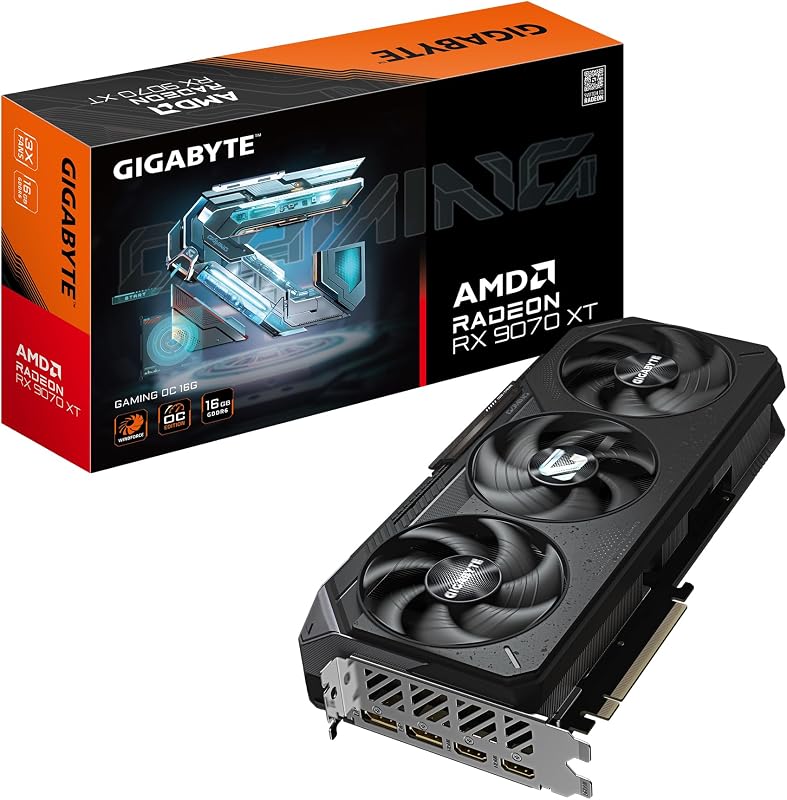
The GIGABYTE Radeon RX 9070 XT is a competing high-performance graphics card built on PCIe 5.0 architecture that offers 16GB of GDDR6 memory. Gamers who prefer an AMD-based graphics setup or who want a higher native VRAM pool for specific memory-heavy workloads may favor this card over the 12GB GDDR7 configuration on the RTX 5070.
ASRock Radeon RX 9070 Challenger

The ASRock Radeon RX 9070 Challenger features a triple-fan cooling system, 16GB of GDDR6 memory on a 256-bit bus, a 2520 MHz boost clock, and 0dB silent fan functionality. It represents an appealing choice for builders who want RDNA 4 architecture and zero-noise operation during low-load tasks while retaining a multi-fan cooling configuration.
PCIe 4.0

For builders operating with strict space constraints or building entry-level gaming systems, the PCIe 4.0 ASUS Dual GeForce RTX 3050 6GB GDDR6 OC Edition provides an ultra-compact alternative. With a dual-fan footprint, legacy DVI-D output alongside HDMI 2.1 and DisplayPort 1.4a, and IP5X dust resistance, it serves shoppers who do not require high-end Blackwell processing power and need a smaller, less demanding card.
Final Verdict
When evaluating if the card delivers on its intended design goals, the ASUS TUF RTX 5070 stands out as a durable, heavy-duty execution of NVIDIA’s Blackwell platform. By pairing a 2640 MHz boost clock and high-speed GDDR7 memory with a massive 3.125-slot heatsink, ASUS has prioritized quiet acoustics, lower running temperatures, and long-term hardware survival. The inclusion of a phase-change thermal pad, protective PCB coating, and robust anti-sag bracket shows a clear focus on enduring build quality.
So, is rtx 5070 tuf worth it for your personal build? If your computer case has the required 13 inches of clearance and you do not mind dedicating more than three PCIe slots to your GPU, this card delivers an exceptionally well-cooled, stable experience with generous display outputs. Everyday gamers looking for a rugged, install-and-forget graphics card that runs cool under heavy loads will find this hardware fully justifies its expansive footprint.
FAQ
What are the primary ASUS TUF RTX 5070 specs?
The card features the NVIDIA GeForce RTX 5070 processor built on Blackwell architecture, 12 GB of GDDR7 memory operating at 2640 MHz, and a boost clock speed of 2610 MHz in default mode and 2640 MHz in OC mode. It supports a maximum digital resolution of 7680×4320 pixels across five output ports.
What are the ASUS TUF RTX 5070 dimensions and case requirements?
The graphics card measures 13 inches in length and 5.5 inches in width, utilizing a 3.125-slot width. You will need a spacious desktop chassis with at least 330 mm of internal clearance and four unobstructed motherboard expansion slot brackets to ensure proper fit and airflow.
What are the ASUS RTX 5070 TUF power supply requirements?
The manufacturer listing does not specify an exact minimum power supply wattage for this model. However, because it runs on a PCIe 5.0 interface with factory overclocking capabilities, builders should pair it with a reputable desktop power supply capable of cleanly supporting modern high-performance graphics hardware.
How does the RTX 5070 TUF vs Founders Edition compare regarding video outputs?
While standard reference designs typically include four video outputs, the ASUS TUF Gaming edition provides five display ports: three DisplayPort 2.1a connections and two HDMI 2.1b ports. This makes it easier to connect multiple displays or high-bandwidth television screens without extra splitters.
Does the card come with mounting hardware to prevent sag?
Yes, the card includes a dedicated TUF graphics card holder and an integrated GPU Guard and bracket to reinforce the PCB assembly and prevent mechanical sag or stress on your motherboard’s PCIe slot.


