
As Amazon Associates, we earn from qualifying purchases. This means we may receive a small commission at no extra cost to you if you click through and make a purchase.
The Rokid AR Spatial is a dedicated wearable computing package that pairs the lightweight Rokid Max2 AR glasses with the standalone Rokid Station2 spatial computing host. By delivering a virtual display canvas of up to 360 inches powered by dual Micro-OLED panels, this hardware combination attempts to solve the fundamental limitation of working and playing on compact mobile screens. Our verdict is that the Rokid AR Spatial stands out as one of the most capable portable triple-display systems on the market, giving travelers and console players a high-refresh wearable workstation, provided its software limitations align with your everyday workflow.
This dual-unit setup directly suits remote professionals seeking multi-monitor productivity without lugging physical monitors, frequent travelers wanting a theater-grade media display on flights, and mobile gamers looking for a lag-free 120Hz screen for consoles. However, shoppers who need full six-degrees-of-freedom positional tracking, room-scale interactive virtual reality, or native astigmatism correction will want to explore traditional VR headsets or prescription-first smart eyewear instead.


Rokid AR Spatial at a Glance

| Feature | Specification |
|---|---|
| Display Type | Micro-OLED (50% larger display area vs. Rokid Max) |
| Resolution | 1920 × 1200 per eye |
| Refresh Rate & Brightness | 120Hz, 600 nits peak brightness |
| Color Gamut | 108% sRGB |
| Glasses Weight | 75 grams |
| Station2 Compute Unit | 0.31 kg, 8GB RAM, 128GB Storage |
| Battery & Runtime | 5000mAh Lithium Ion, approximately 3.5 hours |
| Operating System | YodaOS-Master |
| Head Tracking | 3DoF (Giant Screen & Multi-Screen), 0DoF (Reading & Sports) |
| Diopter Adjustment | 0 to 600 degrees myopia adjustment (no astigmatism support) |
Display Quality and Visual Immersion
Visual fidelity defines the utility of wearable displays, and the Rokid AR Spatial centers its experience on two Micro-OLED screens delivering 1920×1200 resolution. Compared to standard mobile monitors or older head-mounted displays, the visual crispness of text and UI elements is immediately noticeable. Fine spreadsheet rows, code editors, and subtitle tracks remain legible across the field of view without the harsh pixelation or screen-door effect common in early-generation smart glasses. Rokid specifies a peak brightness of 600 nits, which provides sufficient luminance to cut through indoor ambient light and typical passenger cabin glare.
Color performance is backed by a 108% sRGB color gamut coverage, ensuring that high-definition streaming video and vibrant game worlds retain rich saturation without washed-out highlights. When evaluating the visual step forward in the rokid max ar glasses lineup, the Max2 optics feature a 50% larger Micro-OLED display area than the original Rokid Max. This wider visual canvas noticeably expands peripheral visibility and makes larger virtual screen projections feel natural rather than boxed into a tight frame.
Gamers and fast-paced video viewers benefit substantially from the native 120Hz refresh rate. High refresh rates reduce visual latency and eliminate the ghosting or judder that often plagues 60Hz wearable screens during rapid head pans or intense action scenes. When connected to high-framerate video sources, interface animations glide smoothly, preventing the eye fatigue that often accompanies extended viewing sessions on lower-spec hardware.
Virtual Multitasking and Spatial Screen Modes
The core selling point of this package is its productivity-oriented windowing system powered by the Station2 unit. Running on Rokid’s proprietary YodaOS-Master operating system, the system introduces a 3-screen display that allows users to place up to three applications side by side in virtual space. For professionals attempting to compare documents, reference communication channels, and write text concurrently while seated at a coffee shop or on a train, this virtual triple-monitor workspace eliminates the claustrophobic friction of a single laptop display.
Rokid provides four dedicated viewing modes alongside flexible aspect ratios to accommodate different content types:
- Multi-Screen Mode: Distributes three distinct application windows horizontally across your visual perimeter using 3DoF tracking.
- Giant Screen Mode: Projects an expansive single display simulating up to a 360-inch canvas, with aspect ratios stretching from standard 16:9 up to an ultra-wide 32:9.
- Reading Mode: Locks content directly into your line of sight using 0DoF tracking, optimized for text consumption.
- Sports Mode: Keeps the visual feed fixed to head movement in 0DoF, ideal for keeping playback centered during light mobility.
Understanding the distinction between 3DoF and 0DoF tracking is crucial before purchasing. In Multi-Screen and Giant Screen modes, the 3DoF functionality anchors the screens to fixed coordinates in front of you. When you turn your head to the left, you look at your left monitor; when you turn back to center, your primary window remains exactly where you left it. Conversely, Reading and Sports modes lock the window directly in your visual center, following every head tilt. Shoppers must note several platform constraints: the listing explicitly clarifies that Netflix and Apple TV content currently only operates in 0DoF mode, and some specific utility apps like File Assistant do not support ratio adjustment. Furthermore, when projecting from Android smartphones, the 3-screen mode operates exclusively over the DLNA protocol.
Ergonomics, Optical Adjustments, and Wearability
Even the sharpest optics fail if a head-mounted device is uncomfortable, but the Rokid Max2 glasses weigh just 75 grams. This featherweight chassis distributes mass evenly across the brow rather than pressing forward heavily like a full VR headset. The frame incorporates soft, flexible temples that hug the head securely without pinching behind the ears. Rokid also redesigned the nose pad with an airy cushioning structure that minimizes slippage on the bridge of the nose and reduces contact pressure over multi-hour working sessions.
Vision customization is integrated directly into the physical hardware. The glasses feature top-mounted physical adjustment dials that provide myopia correction up to 600 degrees, alongside interpupillary distance adjustment. This optical dial system allows nearsighted users within the 0 to 600-degree range to use the glasses without wearing contact lenses or inserting prescription lens frames. However, the listing notes that users with myopia exceeding 600 degrees cannot rely on the dials alone, and native astigmatism correction is not supported.
Thermal dissipation and cable routing also affect day-to-day comfort. Because the compute hardware, memory, and battery reside entirely inside the external Station2 unit rather than inside the glasses themselves, the frames generate minimal heat against the wearer’s face. While you do have to manage a lightweight USB-C tether connecting the glasses to the Station2, this separation keeps the wearable component remarkably cool and lightweight during extended operation.
Compute Performance, Battery Life, and Controls
The companion Rokid Station2 spatial computer serves as the processing brain and power reservoir for the system. Weighing 0.31 kg (approximately 11 ounces), the Station2 slips easily into a coat pocket or travel bag. Internally, the pocket computer packs 8GB of RAM, 128GB of onboard storage, Wi-Fi 6 networking, and Bluetooth 5.2. This hardware balance provides enough memory and throughput to run YodaOS-Master apps smoothly, cache media files locally, and connect multiple wireless accessories without input stutter.
Power is supplied by an integrated 5000mAh lithium-ion battery that delivers roughly 3.5 hours of continuous runtime on a full charge. While 3.5 hours is ample time for watching a long movie or knocking out an urgent work session, it falls short of an entire transoceanic flight or a full eight-hour workday. Fortunately, the Station2 includes dual USB Type-C ports, enabling simultaneous charging and video output so you can connect a power bank or wall adapter while continuing your workflow.
Navigating the interface relies on versatile input options. The Station2 acts as a handheld spatial pointer, emitting a virtual ray on the display that you aim with hand gestures and confirm with onboard touch controls. Users can also issue voice commands for basic navigation. For serious typing or precision gaming, the system natively pairs with external Bluetooth and USB keyboards, mice, and gamepads. You can also transfer multimedia files directly via the Rokid AR app, and utilize the Spatial Album feature to view three-dimensional photos and videos captured on compatible smartphones.
Gaming and Entertainment Compatibility
Beyond remote productivity, the Rokid AR Spatial serves as a flexible wearable monitor for console gaming and home entertainment. The Station2 app store offers native access to major streaming platforms like Netflix, Prime Video, and YouTube, alongside a library of 3D gaming titles. While the glasses provide directional personal audio through their temples, pairing them with an external audio system such as an lg sound suite h7 when using stationary media setups highlights how wearable displays can integrate into broader multimedia environments.
Console players can tether the Rokid AR Spatial directly to modern gaming systems, including the Nintendo Switch, PlayStation 5, and Xbox series consoles. When connected to gaming hardware, the glasses function as a high-speed personal display, outputting responsive 120Hz imagery with vivid contrast. Playing competitive or cinematic games on a virtual screen that mimics a massive gaming display gives console users a private display experience that does not tie up the living room television.
For audiophiles who prefer expansive physical speaker systems over integrated temple speakers, running gaming consoles through home equipment like a sonos sub speaker setup while wearing the glasses provides the ultimate combination of massive spatial video and room-filling low-end impact. The low latency of the wired Type-C connection ensures that fast-twitch games remain responsive, with zero perceptible controller-to-display lag.
Rokid AR Spatial Pros and Cons
Pros
- Sharp 120Hz Micro-OLED display
- Simultaneous three-screen spatial multitasking
- Lightweight 75-gram glasses with diopter adjustment dials
- Station2 includes dual Type-C ports for charging while playing
- Wide compatibility with Switch, PS5, and Xbox consoles
Cons
- Netflix and Apple TV restricted to 0DoF tracking
- No native astigmatism correction support
- Station2 battery runtime capped at 3.5 hours
- Android three-screen display limited to DLNA protocol
Check Rokid AR Spatial on Amazon
Who Should Buy the Rokid AR Spatial
Buy It If
- You travel frequently and want a private virtual multi-monitor workstation that fits inside a carry-on bag.
- You own a modern gaming console like a PS5, Xbox, or Nintendo Switch and desire a portable 120Hz Micro-OLED gaming screen.
- Your myopia is under 600 degrees without astigmatism, allowing you to use the built-in diopter dials without extra corrective eyewear.
- You want a tethered computing device that handles streaming and spatial apps independently without draining your phone battery.
Skip It If
- You require full 6DoF room-scale motion tracking or spatial VR controllers for fitness and immersive 3D simulation games.
- You suffer from uncorrected astigmatism or have myopia greater than 600 degrees, as the onboard dials cannot compensate for your prescription.
- Your productivity relies heavily on native Android screen mirroring across three windows without relying on DLNA streaming.
Rokid AR Spatial Alternatives Worth a Look
If your daily workflow does not require a dedicated pocket spatial computer and triple-window multitasking, several alternative smart glasses focus on artificial intelligence, hands-free media, and direct capture.
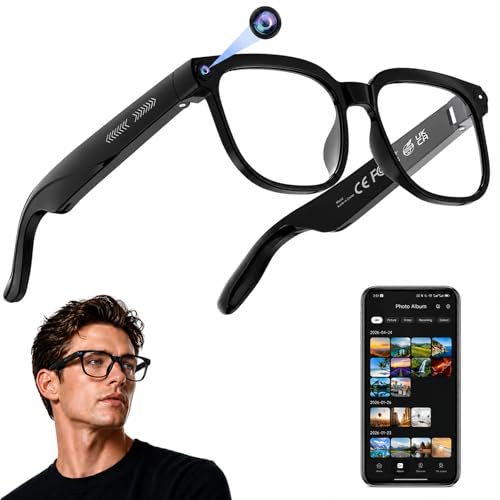
Photo Capture, Real-Time Translation, Object Recognition Glasses
The Photo Capture,Real-Time Translation,Object Recognition,Open-Ear Music glasses are designed for lifestyle capture rather than virtual desktop productivity. This model integrates 4K HD video recording cameras, real-time audio translation, open-ear Bluetooth music playback, and hands-free calling directly into a sunglass frame. Shoppers who want first-person video recording and AI-assisted conversational tools rather than a virtual monitor should pick this option.

AI Assistant Smart Glasses
The AI Assistant smart glasses prioritize everyday eyewear utility, packing photochromic lenses with UV and blue light protection alongside Bluetooth audio, phone call capabilities, and ChatGPT-driven real-time translation. Users who want lightweight daily eyeglasses with ambient audio and smart assistant features instead of a dedicated gaming and multitasking display will find this alternative far more suited to casual daily wear.

Object Recognition Smart Glasses
The Object Recognition glasses combine transparent corrective-style lenses with an integrated camera capable of 4K video recording, object recognition, and AI-driven translation. This device suits mobile professionals and students who need visual search assistance, meeting documentation, and Bluetooth calling in an unobtrusive optical form factor without the weight of an external spatial computing box.

Final Verdict
The Rokid AR Spatial represents a mature step forward in wearable computing, successfully solving the comfort equation with its 75-gram Max2 glasses while offloading processing and battery demands to the pocketable Station2 computer. Its 1920×1200 Micro-OLED panels, rapid 120Hz refresh rate, and 3-screen multitasking workspace deliver genuine utility for mobile workers and console gamers seeking screen real estate beyond the confines of a laptop or tablet.
While platform caveats like 0DoF restrictions on certain streaming apps, DLNA limitations on Android multi-screen casting, and the lack of native astigmatism correction require careful consideration, the core hardware executes its primary mission with impressive visual polish. If you need a private, portable, high-refresh multi-screen setup that you can take anywhere, the Rokid AR Spatial provides a highly capable spatial solution.
FAQ
Can I use the Rokid AR Spatial if I wear prescription glasses?
The Rokid Max2 glasses feature integrated mechanical diopter adjustment dials located on top of the frame that adjust for nearsightedness up to 600 degrees, alongside IPD tuning. If your myopia falls within this 0 to 600-degree range and you do not have astigmatism, you can adjust the dials and view the screens clearly without corrective lenses. However, the listing notes that astigmatism is not supported, and users with myopia exceeding 600 degrees will require external corrective solutions.
Does the Rokid AR Spatial support true 3DoF tracking across all apps?
3DoF tracking—where virtual screens remain anchored in space as you turn your head—is supported specifically in Giant Screen Mode and Multi-Screen Mode. In Reading Mode and Sports Mode, the display operates in 0DoF, meaning the screen follows your head movements directly. Additionally, the product listing explicitly notes that streaming applications such as Netflix and Apple TV currently only operate in 0DoF mode.
How long does the battery last, and can I charge it during use?
The Station2 spatial computer houses a 5000mAh lithium-ion battery that provides approximately 3.5 hours of operating runtime under normal use. To accommodate longer work shifts or gaming sessions, the Station2 includes dual USB Type-C ports, allowing you to connect an external power bank or wall charger to replenish the battery while actively running the glasses.
Can I connect the Rokid AR Spatial to gaming consoles?
Yes, the Rokid AR Spatial supports direct connectivity to popular gaming consoles including the Nintendo Switch, PlayStation 5, and Xbox consoles. When tethered to these systems, the glasses act as a high-definition personal gaming monitor, outputting responsive, lag-free visuals at up to a 120Hz refresh rate.
How does the 3-screen multitasking feature work with smartphones?
The 3-screen multitasking mode allows you to run and view three applications simultaneously side by side within YodaOS-Master on the Station2 unit. If you connect an Android smartphone to project content across the three virtual screens, the product listing specifies that the 3-screen display functionality is supported exclusively via the DLNA protocol.


