
As Amazon Associates, we earn from qualifying purchases. This means we may receive a small commission at no extra cost to you if you click through and make a purchase.
The Canon RF 16mm f/2.8 STM stands out as Canon’s first ultra wide-angle, fixed focal length RF lens designed to bring expansive framing to full-frame mirrorless camera bodies without adding bulk to your camera bag. Combining a broad 16mm focal view with a fast f/2.8 maximum aperture, this featherweight optic is engineered to capture expansive scenes, dynamic video, and clear indoor frames while keeping camera rigs nimble and balanced. Our comprehensive canon rf 16mm review reveals a prime lens that fundamentally changes how creators look at wide-angle capture, delivering a versatile tool that prioritizes go-anywhere convenience and practical optical performance.
This wide-angle prime is tailor-made for vloggers, travel documentarians, landscape enthusiasts, and everyday creators who prioritize portability and wide perspectives over heavy professional zoom lenses. Paired with a compact full-frame body such as the canon eos r8, it creates an effortless walkaround setup that feels almost weightless during long days on foot. However, photographers who require flexible optical zoom, telephoto reach, or legacy compatibility with older DSLR bodies with EF, EF-S, or EF-M lens mounts will need to look elsewhere.


Canon RF 16mm f/2.8 STM at a Glance

| Attribute | Detail |
|---|---|
| Lens Mount | Canon RF (EOS R Series Mirrorless) |
| Focal Length | 16mm Fixed Focal Length Prime |
| Maximum Aperture | f/2.8 |
| Minimum Aperture | f/22 |
| Autofocus Motor | Gear-type Stepping Motor (STM) |
| Minimum Focusing Distance | 5.11 inches |
| Maximum Magnification | 0.26x |
| Diaphragm Blades | 7 Blades |
| Optical Coating | Super Spectra Coating |
| Package Contents | 43mm Front Lens Cap, RF Rear Cap, UV Filter, Lens Cap Keeper |
Field of View and Framing Versatility
The defining strength of this lens is its dramatic 16mm field of view. On a full-frame sensor, 16mm provides an ultra-wide angle of view that draws viewer attention directly into the center of the frame while stretching perspective toward the borders. This makes it an outstanding tool for canon rf 16mm landscape photography, allowing you to capture sweeping mountain horizons, broad ocean vistas, and dramatic foreground textures without having to back up into hazardous terrain. Architectural photography and indoor real estate shots also benefit substantially, as the wide perspective lets you encompass entire rooms, tall buildings, and tight corridors where longer primes feel restricted.
Content creators will find that using the canon rf 16mm for vlogging solves one of the most persistent issues in self-recording: cramped framing. When holding a camera at arm’s length on a mini tripod or hand grip, standard wide lenses often crop too tightly around the face, eliminating all environmental context. At 16mm, your face occupies a natural portion of the upper frame while the background remains clearly visible, giving viewers a genuine sense of location. This wide view also provides ample margin if you utilize digital video stabilization or electronic crop modes in-camera, ensuring your face does not get uncomfortably zoomed in during motion.
Mounting this canon eos r wide angle prime on an APS-C camera body like the R7, R10, R50, or R100 introduces an entirely different creative personality. Due to the 1.6x crop factor on Canon APS-C sensors, the lens behaves like a 25.6mm equivalent focal length. This 25mm-style view functions as a classic wide-angle street and documentary lens, delivering natural perspective without exaggerated ultra-wide stretching at the edges. This versatility gives the optic a dual identity across the entire EOS R family, serving as an ultra-wide field of view on full-frame cameras and a standard wide documentary optic on crop-sensor bodies.
Aperture, Low Light, and Optical Characteristics
Equipped with a bright maximum aperture of f/2.8, this optic offers serious advantages when ambient light starts to fade. In dim living rooms, evening city streets, or shadowed forests, an f/2.8 opening admits significantly more light to the sensor than typical entry-level zoom lenses. This makes canon rf 16mm low light photography and video far more dependable, allowing you to shoot at lower ISO settings to avoid digital noise and maintain faster shutter speeds to prevent motion blur when tracking hand-held action.
That generous f/2.8 gathering capability also makes the optic an enticing candidate for canon rf 16mm astrophotography. Capturing the Milky Way, meteor showers, and starlit landscapes requires an optic that balances a wide field of view with an aperture bright enough to collect faint starlight before Earth’s rotation causes star trailing. At 16mm and f/2.8, you can execute long night exposures that keep stars sharp and pinpoint across the sky. The built-in 7-blade diaphragm also allows you to stop down to f/22 when you want to maximize depth of field across bright daytime scenes or create deliberate sunstar effects around intense specular highlights.
Optical performance is enhanced by Canon Super Spectra Coating, an element treatment designed to suppress internal reflections, flare, and ghosting. When working with ultra-wide lenses, bright ambient sources like the midday sun, streetlamps, or interior lighting fixtures frequently enter the frame. The Super Spectra Coating helps preserve image contrast and color balance across demanding lighting environments. While corner softness and natural optical vignetting are characteristics common to tiny ultra-wide primes, modern Canon EOS R cameras automatically apply dedicated profile corrections to keep lines straight and exposure balanced across the sensor.
Autofocus Speed and Video Tracking
Under the hood, the lens utilizes a gear-type stepping motor (STM) that powers both automatic and manual focus modes. The stepping motor is specifically tuned to provide smooth, quiet, and continuous autofocus during video capture. When recording video, sudden focus shifts can be visually jarring; the gear-type STM moves internal elements in measured, consistent increments. This steady operation ensures that canon rf 16mm autofocus transitions remain organic and professional whether you are shifting focus between your face and a handheld product or panning across a scenic view.
Subject tracking performance is snappy and decisive when paired with Canon Dual Pixel CMOS AF systems found in modern R-series cameras. Because wide lenses naturally exhibit deeper depth of field than telephotos, the autofocus motor only needs to move elements a tiny physical distance to lock onto subjects. The system tracks faces, eyes, and moving objects across the frame with minimal hesitation. The motor also operates with low operating sound, preventing distracting mechanical clicks from bleeding into on-camera microphone audio during indoor vlogging or interview sessions.
For creators seeking manual control, the focus ring allows for fine manual adjustments to nail precise focus planes. Shooters familiar with other lightweight primes like the canon rf 50mm f/1.8 stm will recognize the intuitive balance and quick electronic response of the STM drive. The listing specifications also cite optical image stabilization functionality, working in harmony with camera systems to keep handheld video capture smooth and steady even when walking or operating without a mechanical gimbal.
Portability, Close-Up Capabilities, and Ecosystem Fit
The most immediately striking aspect of the canon rf 16mm f2.8 stm is its diminutive physical footprint. Ultra-wide lenses traditionally require bulky, bulbous front elements and heavy internal barrel assemblies that weigh down a camera bag. In contrast, this lens adopts an ultra-compact, pancake-style profile that barely protrudes from the camera body. Weighing practically nothing and using small 43mm front filters, it encourages you to bring an ultra-wide angle along on every outing rather than leaving heavy glass behind at home or in a hotel room.
Despite its pocket-sized barrel, the lens boasts impressive close-focusing capabilities. It features a minimum focusing distance of just 5.11 inches, paired with a maximum magnification ratio of 0.26x. Getting within five inches of a subject with an ultra-wide lens produces dramatic, exaggerated close-up imagery. You can place small objects, flowering plants, or food items directly in front of the front glass while retaining an expansive, cinematic background. This close-focus ability unlocks creative framing techniques that standard zoom lenses simply cannot replicate.
When assessing the canon rf 16mm specs, system compatibility is an essential consideration for prospective buyers. This lens is built exclusively for Canon RF mount mirrorless cameras, including full-frame models like the R5, R6, and R8, alongside APS-C models such as the R7, R10, R50, and R100. It is physically and electronically incompatible with legacy Canon DSLRs using EF or EF-S mounts, and it cannot be attached to discontinued EF-M mirrorless cameras. Understanding where this optic fits in your lens collection is straightforward: while a standard zoom such as the canon rf 24-105mm f4-7.1 is stm provides everyday focal flexibility, this 16mm prime delivers specialized ultra-wide perspective and superior f/2.8 light gathering in a package that fits in a jacket pocket.
Canon RF 16mm f/2.8 STM Pros and Cons
Pros
- Lightweight and compact ultra-wide pancake-style build
- Bright f/2.8 maximum aperture for low light
- Smooth and quiet gear-type STM video autofocus
- Close minimum focusing distance of 5.11 inches
- Includes UV filter and lens cap keeper
Cons
- Incompatible with Canon EF, EF-S, and EF-M mounts
- Fixed 16mm focal length provides no optical zoom
- Uses gear-type STM rather than ultrasonic focus motor
Check Canon RF 16mm f/2.8 STM on Amazon
Who Should Buy the Canon RF 16mm f/2.8 STM
Buy It If
- You need a featherweight, pocket-sized ultra-wide lens for handheld vlogging, YouTube video, and daily video content.
- You shoot landscapes, architecture, or tight interior spaces and want an expansive 16mm view on a full-frame EOS R camera.
- You want a fast f/2.8 maximum aperture for indoor low-light shooting or entry-level night sky astrophotography.
- You enjoy dramatic perspective close-ups thanks to its short 5.11-inch minimum focusing distance.
Skip It If
- You primarily shoot on Canon DSLR bodies with EF or EF-S mounts, or older EOS M mirrorless cameras.
- You require a versatile zoom range to switch between wide views and telephoto focal lengths without swapping lenses.
- You demand silent, ultra-high-speed USM focus drives for high-end professional studio production.
Canon RF 16mm f/2.8 STM Alternatives Worth a Look
While this compact prime offers unique advantages for Canon mirrorless owners, shoppers exploring different camera mounts and zoom requirements may want to consider other versatile optics on the market.
Tamron 17-70mm f 2.8 Di

The Tamron 17-70mm f 2.8 Di is designed specifically for Sony E APS-C mirrorless cameras, featuring a flexible 17-70mm focal range paired with a constant f/2.8 maximum aperture and VC vibration compensation. Creators shooting on the Sony APS-C system who want an all-in-one workhorse zoom rather than a fixed prime should evaluate this alternative.
G-Master Standard Zoom Lens

The G-Master Standard Zoom Lens represents Sony’s FE 24-70mm F2.8 GM II full-frame standard zoom lens. Professional photographers operating within the Sony full-frame ecosystem who need versatile zoom coverage spanning from wide 24mm framing up to 70mm portrait lengths will find this premium zoom better suited to general assignment work than a single focal length wide prime.
CanonMirrorless Ultra Wide-Angle
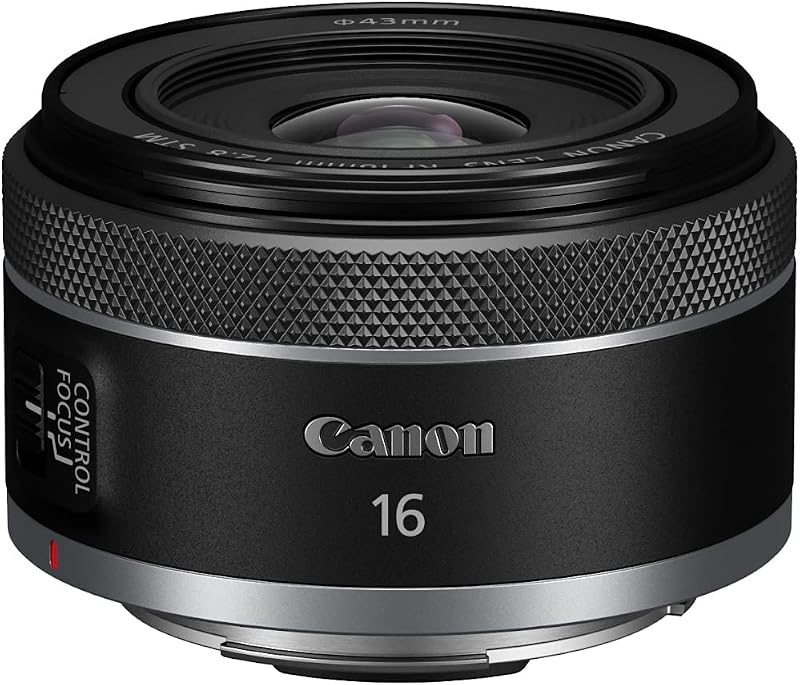
The CanonMirrorless Ultra Wide-Angle listing represents the standalone RF 16mm F2.8 STM lens package for Canon EOS R series mirrorless cameras. If you already own compatible 43mm protective filters and do not need the additional lens cap keeper or bundled UV filter included in the main three-item kit, this standalone listing offers the exact same optical performance.
Final Verdict
The Canon RF 16mm f/2.8 STM successfully fills a crucial niche in the RF lens ecosystem by pairing an expansive 16mm field of view with an ultra-compact, travel-ready design. With its bright f/2.8 maximum aperture, dependable gear-type STM video autofocus, and Super Spectra Coating, it grants creators the freedom to record immersive video, detailed landscapes, and clean low-light frames without carrying heavy support equipment. The close 5.11-inch focusing distance further expands its utility, allowing for dynamic perspective photography that sets your visual work apart.
When asking the question, is canon rf 16mm worth it, the answer is a resounding yes for any Canon EOS R photographer or videographer looking to expand their optical horizons. By delivering true ultra-wide perspectives, responsive autofocus tracking, and featherweight portability in an accessible package, this prime earns a permanent spot in any travel kit, vlogging setup, or hiking pack.
FAQ
Is the Canon RF 16mm f/2.8 STM compatible with Canon DSLR cameras?
No. The lens is built exclusively for Canon mirrorless cameras that utilize the Canon RF lens mount. It is not compatible with Canon DSLR cameras that use EF or EF-S mounts, nor can it be mounted on older Canon EOS M mirrorless cameras using the EF-M mount.
Can I use this lens on crop-sensor cameras like the Canon EOS R50 or R7?
Yes. The lens mounts natively to all Canon EOS R series mirrorless cameras, including APS-C sensor models like the R100, R50, R10, and R7. On these cameras, the 1.6x crop factor gives the lens a 25.6mm equivalent focal length, functioning as a practical standard wide-angle optic.
What accessories are included in this specific lens package?
The package includes the Canon RF 16mm f/2.8 STM lens, a Canon 43mm front lens cap, a Canon RF rear lens cap, a protective UV filter, and a lens cap keeper strap.
How close can the Canon RF 16mm f/2.8 STM focus on a subject?
The lens features a minimum focusing distance of 5.11 inches (approximately 13 centimeters) and delivers a maximum magnification of 0.26x, allowing you to capture exaggerated close-up shots with expansive background context.
Does the Canon RF 16mm f/2.8 STM have optical image stabilization?
The Amazon listing specifications cite optical image stabilization for this lens, which works alongside compatible EOS R camera bodies to steady handheld video recording and keep stills sharp in dim environments.
What type of autofocus motor does this lens use?
The lens uses a gear-type stepping motor (STM) engineered to provide smooth, quiet, and reliable continuous autofocus performance, making it well suited for tracking movement during video recording and capturing quick still images.


