
As Amazon Associates, we earn from qualifying purchases. This means we may receive a small commission at no extra cost to you if you click through and make a purchase.
The Canon Rebel T3, frequently looked up by prospective photographers as the cannon rebel t3, is a foundational digital single-lens reflex camera designed to introduce new users to manual exposure and interchangeable glass. Packaged with both an 18-55mm IS II lens and a 75-300mm telephoto zoom lens, this camera serves as an entry point for anyone wanting to move beyond point-and-shoot snapshots into disciplined image creation. The direct verdict on this model is straightforward: it delivers an uncomplicated, hardware-driven photographic foundation that successfully teaches the core exposure triangle without distracting menu bloat, even if its auxiliary multimedia features show their age.
This camera suits students, hobbyists, and visual learners who want physical dials, an optical viewfinder, and real mechanical control over shutter speed, aperture, and ISO. The bundled two-lens kit provides an immediate range from moderate wide-angle framing to long-range telephoto reach without requiring immediate accessory investments. Conversely, content creators, vloggers, and modern hybrid shooters looking for ultra-high-definition video, articulated touchscreens, or high-speed action tracking should look toward modern mirrorless setups or advanced bodies instead.


Canon Rebel T3 at a Glance

| Feature | Specification |
|---|---|
| Effective Still Resolution | 12.2 Megapixels |
| Sensor Type and Dimensions | APS-C CMOS (22.2 x 14.8 mm) |
| Lens Mount Compatibility | Canon EF and Canon EF-S |
| Autofocus Hardware | 9-point AF system |
| Continuous Shooting Speed | Up to 3 frames per second |
| ISO Sensitivity Range | 100 to 6400 |
| Shutter Speed Parameters | 1/4000 to 30 seconds |
| Video Capture Standard | 720p HD recording |
| Rear Monitor Specifications | 2.7-inch LCD screen (230,000 dots) |
| Chassis Form Factor and Weight | Compact SLR at 1.1 pounds |
Sensor Resolution and Image Quality
At the center of the camera sits an APS-C CMOS sensor delivering 12.2 effective megapixels. While modern smartphone cameras boast astronomical pixel counts through aggressive computational processing, the physical surface area of this APS-C chip measures 22.2 by 14.8 millimeters. That larger sensor footprint ensures clean light gathering, authentic optical depth of field, and genuine background blur that artificial software filters struggle to replicate cleanly. For everyday shooting, family portraits, and outdoor landscapes, the output delivers realistic color gradation and pleasant contrast directly to memory cards.
In this Canon Rebel T3 review, evaluating file formats proves essential for those practicing post-processing techniques. The hardware supports both standard JPEG compression and uncompressed RAW image capture. Shooting in RAW captures the complete exposure data detected by the Canon Rebel T3 12MP sensor, allowing users to pull shadow detail, adjust white balance, and tame bright highlights in image editing software. While newer platforms like the cannon rebel t7 provide substantially higher megapixel thresholds, 12.2 megapixels remains fully capable of producing crisp standard-format prints and high-clarity web imagery without eating up vast quantities of computer storage.
The sensitivity range spans an ISO range from 100 to 6400, offering baseline flexibility when lighting conditions shift. At lower values between ISO 100 and 400, images display clean textures and minimal digital grain, making outdoor sessions rewarding. As ambient light diminishes and sensitivity climbs to ISO 1600 or 3200, luminance noise begins to emerge across flat shadows, and the ceiling of ISO 6400 should be reserved strictly for emergencies where securing a sharp exposure outweighs pristine clarity. Practicing Canon Rebel T3 photography under controlled daylight teaches students how to balance ambient illumination, shutter duration, and sensor sensitivity effectively.
Autofocus Performance and Burst Capture
Framing subjects accurately relies on an integrated 9-point autofocus system arranged across the central viewing frame. The autofocus points form a diamond pattern across the viewfinder, anchoring the center with a cross-type sensor that locks onto horizontal and vertical contrast variations reliably. While the peripheral points handle static subjects well under bright conditions, the center point consistently exhibits the fastest lock-on speed and highest precision when working with low-contrast surfaces or dim lighting.
Continuous shooting tops out at 3 frames per second. This modest burst rate reinforces measured timing rather than reckless spray-and-pray techniques. If you intend to document fast-paced track meets, sprinting pets, or erratic birds in flight, 3 fps requires anticipation and careful shutter pacing. However, for casual street scenes, group portraits, children playing at normal paces, and general travel documentation, the burst speed provides enough rapid sampling to capture expressive moments without filling the memory buffer prematurely.
The physical mode dial on top of the chassis includes dedicated creative and automated presets, including Portrait, Landscape, and Sports modes. The Sports mode instructs the internal processor to favor faster shutter speeds up to the camera limit of 1/4000 second to freeze motion, while Portrait mode prioritizes wider apertures to isolate human subjects from background distractions. These automated presets give newcomers immediate operational confidence before they switch over to fully manual exposure control.
Lens Compatibility and Optical Range
A primary mechanical advantage of this camera is its broad compatibility across the historic Canon EF and EF-S lens catalog. Understanding Canon Rebel T3 lens compatibility gives an aspiring photographer room to expand their toolkit indefinitely. Unlike fixed-lens compact cameras, this DSLR allows owners to attach dozens of classic prime lenses, macro tools, wide zooms, and specialized optics produced across several decades of camera development. Exploring our analysis of the canon rebel t3i demonstrates how having access to that expansive EF-mount ecosystem transforms a basic camera body into a scalable photography workstation.
The specific package under review includes two lenses that solve the common dilemma of focal reach: the EF-S 18-55mm IS II standard zoom and the EF 75-300mm f/4-5.6 III telephoto zoom. The 18-55mm lens covers everyday focal lengths ranging from semi-wide vistas to normal portrait perspectives. Equipped with optical image stabilization (designated as IS II), this lens counteracts subtle hand tremors, making it much easier to achieve tack-sharp images when shooting handheld at slower shutter speeds.
The accompanying EF 75-300mm lens extends framing capabilities toward distant subjects, making wildlife, field athletics, and architectural details accessible. This lens features a maximum aperture of f/4 at its widest end, tapering down to f/5.6 at the 300mm telephoto boundary. While the 75-300mm unit lacks optical stabilization, pairing it with the camera body’s shutter adjustments up to 1/4000 second allows disciplined users to freeze movement outdoors in strong natural light. Together, these two lenses cover an enormous focal continuum without forcing the owner to seek extra hardware right away.
Controls, Display, and Field Ergonomics
Weighing approximately 1.1 pounds for the bare body, the camera maintains a lightweight, compact SLR form factor that does not strain wrists during prolonged afternoon walks. The exterior shell is shaped with an ergonomic right-hand grip contoured to give fingers a secure, tactile hold. Physical buttons, a dedicated mode dial, and a tactile command wheel ensure that shutter duration and menu settings are accessible through muscle memory rather than multi-layered touchscreen taps.
The back of the body houses a 2.7-inch LCD screen displaying 230,000 dots of resolution. By contemporary standards, this rear monitor is relatively small and basic. It serves adequately for reviewing framing parameters, checking exposure histograms, and confirming subject position, but it does not deliver the hyper-crisp rendering or touch-based interaction found on modern smartphones. In bright, direct sunlight, checking subtle focus sharpness on this monitor can require cupping a hand around the bezel or relying strictly on the optical viewfinder for composition.
To ease the learning curve, the internal software provides both a Basic+ control menu and an accessible Quick Menu (Q-menu). The Q-menu consolidates frequently adjusted settings—such as white balance, autofocus patterns, drive modes, and flash compensation—onto a single screen accessed by pressing a single hardware button. The menu system also includes dedicated configuration options for Eye-Fi wireless SD cards, allowing shooters who utilize compatible cards to transmit photos wirelessly to external drives or computers without tethered cables.
Video Limitations and Hybrid Shooting Considerations
Examining the Canon Rebel T3 video capability highlights the deliberate separation between stills photography and moving images on this platform. The camera supports 720p HD video recording rather than 1080p Full HD or 4K. For students documenting quick reference footage, classroom lectures, or basic video diaries, 720p provides manageable files that require minimal computer processing power to edit and share.
However, modern creators looking to produce high-end streaming content, professional social media reels, or cinematic short films will find the video implementation restrictive. The fixed 2.7-inch rear screen cannot articulate outward to help you frame talking-head videos, and the chassis lacks an external microphone input. Audio capture relies entirely on the integrated monaural microphone, which picks up ambient room echo and mechanical focus noises if the lens autofocuses during a take. Reviewing our dedicated canon eos rebel t3 resource reinforces that this model was conceived primarily as a dedicated stills camera with basic video convenience tacked on, rather than a modern video-centric production unit.
The camera features both digital and optical image stabilization options depending on the operating mode and the specific lens mounted to the body. When shooting moving sequences with the 18-55mm IS II lens, the optical mechanism actively absorbs small hand vibrations, helping smooth out handheld footage. Nonetheless, those who envision video recording as fifty percent or more of their workflow should prioritize dedicated multimedia cameras designed around modern continuous video autofocus.
Canon Rebel T3 Pros and Cons
Pros
- Dual-lens kit covers broad focal ranges
- Extensive EF and EF-S lens compatibility
- Lightweight compact SLR body at 1.1 pounds
- Dedicated Q-menu provides quick setting access
- Supports uncompressed RAW image capture
Cons
- Video resolution limited to 720p HD
- Small 2.7-inch display with 230,000 dots
- Continuous burst speed capped at 3 fps
Check Canon Rebel T3 on Amazon
Who Should Buy the Canon Rebel T3
Buy It If
- You want an accessible tool to learn manual exposure, shutter speeds, and aperture settings.
- You want a complete dual-lens kit out of the box that covers wide-angle to 300mm telephoto perspectives.
- You value a lightweight, traditional DSLR body with an optical viewfinder and dependable physical buttons.
- Your primary objective is still photography rather than high-resolution video production.
Skip It If
- You require Full HD 1080p or 4K video capture for serious digital content creation.
- You shoot fast sports or erratic wildlife that demand high-speed burst rates above 3 fps.
- You depend on a large, tilting touchscreen to compose shots from high or low vantage points.
Canon Rebel T3 Alternatives Worth a Look
If the specific trade-offs of this entry-level DSLR do not match your visual priorities, several alternative imaging devices fulfill distinct photographic needs across different operational categories.
8K Digital Cameras for Photography
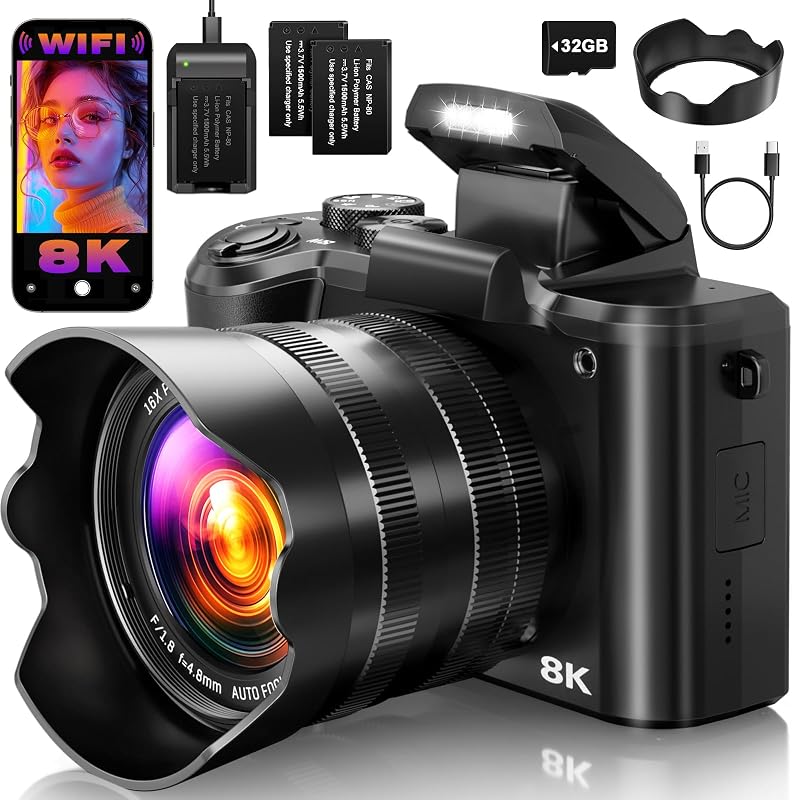
The 8K Digital Cameras for Photography is a modern multimedia compact camera built with an 88MP sensor resolution claim, dual lenses designed for YouTube creators, integrated Wi-Fi, a touchscreen, and two included batteries with a charging stand. Content creators who care primarily about self-facing video capture, integrated wireless file sharing, and plug-and-play web usability should select this device over an older optical DSLR.
1080p Full HD Video

The 1080p Full HD Video bridge camera (KODAK PIXPRO AZ528) features 16MP resolution, an expansive 52x optical zoom starting at 24mm wide, a 3-inch LCD, 6fps burst shooting, and 1080p Full HD video. It represents a practical alternative for travel enthusiasts who demand immense telephoto range without carrying multiple separate lenses or swapping glass in dusty outdoor environments.
Nikon D7500 20.9MP DSLR Camera

The Nikon D7500 20.9MP DSLR Camera pairs an advanced 20.9MP DX sensor with an AF-S DX NIKKOR 18-140mm f/3.5-5.6G ED VR lens. Serious enthusiasts who want a modern, rugged DSLR ecosystem with significantly higher image resolution, superior low-light sensitivity, faster processing, and deeper professional controls should step up to this category of camera.
Final Verdict
A central question for shoppers today is whether the Canon Rebel T3 is worth it when newer models and mirrorless options dominate camera store shelves. The reality is that the physical laws of photography have not changed: light still travels through glass onto an optical sensor, governed strictly by shutter speed, aperture diameter, and sensor sensitivity. In that respect, the Canon Rebel T3 for beginners remains an exceptionally effective classroom. Its straightforward layout forces you to engage with the fundamentals of photography instead of relying on computational algorithms to make aesthetic choices for you.
While the 720p video capability and the 2.7-inch 230,000-dot screen clearly show the platform’s hardware age, the core Canon Rebel T3 specs deliver exactly what an aspiring photographer needs to develop real technical skills. Bundled with both the 18-55mm IS II and 75-300mm zoom lenses, this package equips you to shoot landscapes, portraits, street scenes, and distant details right away. If your goal is to master manual photography with a lightweight, dependable DSLR that accepts hundreds of exceptional lenses, this classic Rebel remains a solid and practical learning companion.
FAQ
What is the video recording resolution of the Canon Rebel T3?
The Canon Rebel T3 records video at 720p HD resolution. It does not offer 1080p Full HD or 4K capture, making it best suited for casual clips rather than modern video production.
Does the Canon Rebel T3 support RAW photo capture?
Yes, the camera can capture both RAW and JPEG file formats. Shooting in RAW records uncompressed data from the 12.2MP sensor, giving you wide latitude to edit exposure and color balance later.
Can I use older Canon lenses on this camera?
The camera features full lens compatibility with both Canon EF and Canon EF-S lens mounts. This allows you to mount a wide variety of prime, wide-angle, and telephoto lenses manufactured for Canon DSLRs.
Does the camera have built-in Wi-Fi connectivity?
The camera body does not include native integrated Wi-Fi hardware. However, its internal menu system includes dedicated software support for Eye-Fi wireless SD cards, allowing wireless file transfers when using compatible cards.
Is the Canon Rebel T3 fast enough for professional sports photography?
With a continuous shooting speed of up to 3 frames per second and a 9-point autofocus array, the camera is designed for basic action tracking rather than demanding professional sports. It can freeze action outdoors using shutter speeds up to 1/4000 second, but rapid-fire bursts require careful manual timing.
If you eventually outgrow the aging autofocus system or require modern video capabilities, comparing top Mirrorless Picks offers a clear view of compact alternatives with real-time electronic viewfinders. Until those technical limitations hinder your creative growth, the Rebel T3 remains an effective, budget-friendly platform for mastering manual exposure.
Testing your aperture settings in a backyard environment provides an easy way to understand how depth of field works in everyday scenarios. Capturing detailed textures across different Patio Set Picks gives beginners immediate feedback on lens sharpness, focus accuracy, and exposure control. This hands-on practice ensures you master the camera hardware before taking on more demanding photography projects.
Once you transfer your RAW captures to a desktop, smooth batch editing in modern software demands adequate system memory. Reviewing solid RAM Kit Picks ensures your workstation handles large photo libraries and multi-layer adjustments without frustrating bottlenecks. Pairing a dependable entry-level DSLR with a responsive editing setup completes the entire creative workflow efficiently.


