
As Amazon Associates, we earn from qualifying purchases. This means we may receive a small commission at no extra cost to you if you click through and make a purchase.
The Canon EF-S 55-250mm IS STM is a dedicated telephoto zoom lens engineered specifically for Canon APS-C format digital SLR cameras. Serving as the natural second lens for photographers who started with an 18-55mm standard zoom, it bridges the gap between everyday casual shooting and distant subject capture. Our comprehensive Canon EF-S 55-250mm F4-5.6 IS STM review finds that this lens delivers sharp image performance, smooth autofocus tracking, and dependable optical stabilization within an accessible, lightweight package.
This telephoto zoom is an outstanding match for amateur wildlife spotters, parents tracking kids across outdoor sports fields, and travelers wanting extra reach without carrying heavy gear. Photographers exploring Canon EF-S 55-250mm for beginners will appreciate how effortlessly it handles outdoor action. Conversely, working professionals who photograph indoor sports in dim arenas or creators shooting on full-frame camera systems will find the variable aperture and crop-sensor mount incompatible with their setup.
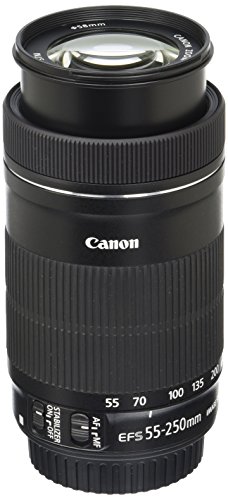


Canon EF-S 55-250mm IS STM at a Glance

| Lens Specification | Manufacturer Detail |
|---|---|
| Focal Length | 55-250mm (35mm equivalent: 88-400mm) |
| Lens Mount Compatibility | Canon EF-S (APS-C DSLRs) |
| Maximum Aperture | f/4 – 5.6 |
| Minimum Aperture | f/32 |
| Autofocus Motor | Stepper Motor (STM) |
| Image Stabilization | Up to 3.5 to 4 stops shake correction |
| Optical Construction | Six-group zoom system with One UD lens element |
| Lens Coating | Super Spectra Coating |
| Minimum Focusing Distance | 2.79 feet (0.85 meters) across full range |
| Maximum Magnification | 0.29x (at telephoto end) |
| Filter Thread Diameter | 58mm (5.8 cm) |
| Diaphragm Blades | 7 blades |
Telephoto Reach and Optical Construction
Understanding the full scope of the Canon EF-S 55-250mm specs begins with focal length multiplication. Because this lens is built exclusively for APS-C sensors, Canon crop factor of 1.6x transforms the physical 55-250mm focal range into an effective 35mm equivalent field of view of 88mm to 400mm. This substantial magnification allows everyday shooters to isolate far-off subjects without physically moving closer. The Canon 55-250mm telephoto reach provides ample zoom for frame-filling captures of backyard birds, sideline action at soccer games, and architectural details across town squares.
To preserve visual clarity across that expansive zoom range, the optical design incorporates a six-group zoom configuration that includes one Ultra-low Dispersion (UD) glass element. Telephoto lenses frequently suffer from chromatic aberration, also known as color fringing, where high-contrast edges display purple or green halos. The specialized UD element directly combats this optical defect, yielding clear contrast and crisp edge definition. Complementing the glass elements is Canon Super Spectra Coating, which reduces interior barrel reflections to minimize flaring and ghosting when shooting under harsh midday sunlight.
Close-up flexibility is another unexpected asset of this telephoto design. The lens maintains a minimum focusing distance of 2.79 feet (0.85 meters) across the entirety of its focal range. When zoomed fully to 250mm, it achieves a maximum magnification of 0.29x. While not a substitute for a true 1:1 macro lens, this capability allows photographers to capture tight portraits of garden flowers, perched insects, and small wildlife without losing focus lock. When considering the Canon EF-S 55-250mm for wildlife, this close-focus threshold offers incredible utility for small animals that stay just out of arm reach.
Autofocus Speed and Stepping Motor Operation
A crucial upgrade in this lens iteration is the implementation of Canon Stepper Motor technology. Evaluating Canon 55-250mm STM autofocus performance reveals a dramatic difference compared to traditional mechanical micro-motors. Stepper motors utilize precise magnetic pulsing to drive optical elements smoothly and quietly. When acquiring focus on moving targets, the mechanism operates almost soundlessly, preventing abrupt gear grinding that can distract subjects or ruin spontaneous outdoor moments.
Photographers stepping up from standard bundle kits, such as the Canon EOS Rebel T7 double zoom kit, will immediately recognize the autofocus improvement over older non-STM telephoto designs. The STM mechanism ensures rapid focus acquisition in daylight, tracking subjects across the frame reliably. Because telephoto depths of field can be razor thin at longer focal lengths, quick drive speeds are essential for keeping erratic subjects like running pets or soaring birds crisp in the frame.
Video creators also gain a massive advantage from the stepping motor integration. When recording video clips on compatible DSLRs, focus transitions appear cinematic rather than jerky. The near-silent drive prevents mechanical autofocus chatter from being picked up by the camera internal microphone. The seven-blade circular aperture diaphragm works alongside the focus assembly, ensuring that out-of-focus background highlights remain pleasantly soft and circular rather than angular and distracting.
Image Stabilization and Low-Light Handling
Handholding a telephoto lens at 250mm requires exceptional stability, making Canon EF-S 55-250mm image stabilization one of the most vital features on this optic. According to official performance figures evaluated against CIPA standards using an EOS 7D at the 250mm focal length (400mm equivalent), the built-in optical image stabilizer provides up to 3.5 equivalent stops of shake correction, with listing specifications noting up to 4 stops overall. This stabilization counteracts the micro-vibrations caused by hand tremor, allowing photographers to shoot handheld at significantly slower shutter speeds than traditional physics would normally dictate.
Under the conventional reciprocal shutter speed rule, shooting handheld at a 400mm effective focal length requires a shutter speed of around 1/400 of a second to prevent motion blur. With multi-stop stabilization actively compensating for camera movement, shooters can comfortably drop shutter speeds down into ranges like 1/50 or 1/60 of a second for static subjects. This capability helps compensate for the lens variable maximum aperture, which begins at f/4 at the wide 55mm end and narrows down to f/5.6 by the time you reach 250mm.
While the optical stabilization excels at neutralizing camera movement, shooters must understand its limits regarding subject motion. Stabilization keeps the lens steady, but it cannot freeze a sprinting athlete or a taking-off bird in dim light. In low-light indoor gymnasiums or shaded forest floors, the f/5.6 aperture restriction means you must raise your camera ISO sensitivity to maintain fast shutter speeds. For outdoor daylight, afternoon sports, and bright overcast conditions, however, the stabilization system delivers consistent, sharp results straight out of the camera.
Build Quality, Handling, and Mount Compatibility
Handling and physical layout play a major role in how often an everyday lens leaves the gear closet. Measuring 6.7 inches long, 4.6 inches wide, and 4.3 inches high in its packaged form, and weighing a modest 1.2 pounds, this zoom avoids the burdensome fatigue common to massive professional telephoto glass. Photographers can easily carry it on a neck strap for an afternoon hike or pack it into a small messenger bag without feeling weighted down.
A central consideration before buying is verifying Canon EF-S 55-250mm compatibility with your existing camera body. The lens features a dedicated Canon EF-S mount engineered exclusively for Canon APS-C DSLR bodies. It mounts natively to all EOS Rebel models, the EOS 70D, 80D, 90D, and the 7D series. It cannot be mounted to full-frame Canon DSLRs such as the 5D or 6D families, as the rear optical element protrudes deeper into the mirror box and would interfere with full-frame mirror mechanisms.
Shooters exploring modern mirrorless systems like the Canon EOS R50 18-45mm setup or video-focused bodies like the Canon EOS R50 V cannot mount this lens natively because mirrorless bodies use the Canon RF mount. However, because EF-S lenses communicate electronically, you can utilize this lens on EOS R mirrorless cameras with a dedicated EF-to-RF mount adapter. Inside the box, the product kit includes the lens, an E-58II lens front cap, an E rear lens dust cap, an instruction manual, and a one-year warranty card.
Canon EF-S 55-250mm IS STM Pros and Cons
Pros
- Up to 4 stops of optical image stabilization
- Quiet and smooth STM stepping motor autofocus
- UD glass element reduces chromatic aberration
- Generous 88-400mm equivalent reach on APS-C
- Close 2.79-foot minimum focusing distance
- Compact and lightweight 1.2-pound construction
Cons
- Variable f/4-5.6 maximum aperture limits low light
- Incompatible with full-frame Canon DSLRs
- Requires adapter for EOS R mirrorless bodies
Check Canon EF-S 55-250mm IS STM on Amazon
Who Should Buy the Canon EF-S 55-250mm IS STM
Buy It If
- You own a Canon APS-C DSLR and want powerful 400mm equivalent telephoto reach without carrying heavy gear.
- You need steady handheld shooting enabled by 3.5 to 4 stops of optical image stabilization.
- You record family video or capture sports and desire quiet, smooth STM stepping motor autofocus tracking.
- You want a dedicated close-focusing telephoto zoom capable of 0.29x magnification for garden wildlife and details.
Skip It If
- You shoot exclusively on a full-frame Canon DSLR body that requires standard EF mount lenses.
- You primarily photograph fast action inside dimly lit sports arenas where a wide f/2.8 constant aperture is necessary.
- You shoot native Canon RF mirrorless cameras and prefer not to deal with an external mount adapter.
Canon EF-S 55-250mm IS STM Alternatives Worth a Look
If your photographic requirements lean toward different camera mounts, wider focal lengths, or full-frame sensor coverage, several other zoom lenses on the market offer distinct capabilities worth considering.
Tamron 17-70mm f 2.8 Di

The Tamron 17-70mm f 2.8 Di III-A VC RXD Lens is built specifically for Sony E mount APS-C mirrorless cameras rather than Canon DSLRs. It offers a fast constant f/2.8 maximum aperture across a versatile wide-to-portrait range with built-in vibration compensation. Sony crop-sensor shooters seeking a bright standard zoom for low-light situations should look here instead of telephoto alternatives.
G-Master Standard Zoom Lens

The G-Master Standard Zoom Lens, representing the Sony FE 24-70mm F2.8 GM II, is an advanced, lightweight standard zoom designed for professional Sony full-frame mirrorless cameras. It provides high-end optical performance across everyday focal lengths, making it ideal for full-frame Sony creators who demand constant f/2.8 brightness across standard zoom perspectives.
Canon RF100-400mm F5.6-8 is USM

For photographers using modern Canon EOS R series mirrorless bodies, the Canon RF100-400mm F5.6-8 is USM provides native telephoto reach without requiring an adapter. With a focal length spanning from 100mm to 400mm and built-in image stabilization driven by an ultrasonic motor, it serves as the modern mirrorless alternative for users seeking extreme distance reach.
Final Verdict
When weighing all features against practical use cases, is Canon EF-S 55-250mm worth it for the everyday crop-sensor shooter? Absolutely. By combining a generous 88-400mm equivalent reach with an advanced six-group optical system and a specialized UD element, this lens overcomes the typical sharpness limitations of entry-tier telephoto zooms. The stepper motor delivers near-silent, accurate autofocus that transitions cleanly between high-resolution still photography and casual HD video recording.
While the variable f/4-5.6 aperture demands good ambient lighting or higher ISO levels indoors, the built-in optical image stabilization system provides the steady handheld platform necessary for capturing sharp frames at the long end of the zoom. For anyone seeking to expand their Canon APS-C DSLR capabilities into sports, wildlife, and distant portraits, this compact telephoto zoom remains a benchmark companion lens.
FAQ
Can I use the Canon EF-S 55-250mm IS STM on a full-frame camera?
No, this lens features an EF-S mount engineered exclusively for Canon APS-C sensor DSLRs. It will not mount to full-frame Canon cameras like the 5D or 6D series, as the mechanical construction extends deeper into the mount and can damage the mirror assembly.
Is the Canon EF-S 55-250mm IS STM good for wildlife photography?
Yes, its 250mm maximum reach translates to a 400mm 35mm equivalent field of view on Canon crop sensors, which is ideal for backyard birds, zoo excursions, and local wildlife. It also boasts a close minimum focusing distance of 2.79 feet for smaller creatures.
What accessories are included in the box with this lens?
The listing kit includes the Canon EF-S 55-250mm F4-5.6 IS STM telephoto lens, the Canon E-58II front lens cap, the Canon E rear lens dust cap, an instruction book, and a one-year warranty card.
What filter size does this lens require?
The lens uses a 58mm front filter thread (listed as 5.8 centimeters), allowing you to attach standard protective UV filters, circular polarizers, or neutral density filters directly onto the front barrel.
Can I mount this lens on Canon mirrorless cameras?
This lens cannot mount directly to Canon EOS R series mirrorless cameras because it uses the EF-S bayonet mount. However, you can use it on EOS R mirrorless bodies if you attach an official Canon EF-EOS R mount adapter, which maintains electronic communication.


