
As Amazon Associates, we earn from qualifying purchases. This means we may receive a small commission at no extra cost to you if you click through and make a purchase.
The Atari Video Computer System defined an entire generation of home entertainment, establishing living room gaming through interchangeable cartridges and clever hardware compromises. In Racing the Beam, authors Nick Montfort and Ian Bogost examine how the severe technical constraints of this pioneering console shaped game design, culture, and creative engineering. For retro enthusiasts and media historians, this volume delivers a lucid, essential portrait of computing history, demonstrating how strict hardware limitations fueled groundbreaking creative expression in early software.
This study suits retro gaming enthusiasts, media researchers, and curious technology readers who want to understand the engineering ingenuity behind 1970s game development without getting lost in impenetrable technical jargon. Those searching for a lightweight, nostalgic coffee-table picture book, a corporate biography of Silicon Valley executives, or a practical assembly programming manual containing full disassembly code should look elsewhere, as this work concentrates strictly on architectural analysis and platform methodology.

Racing the Beam at a Glance
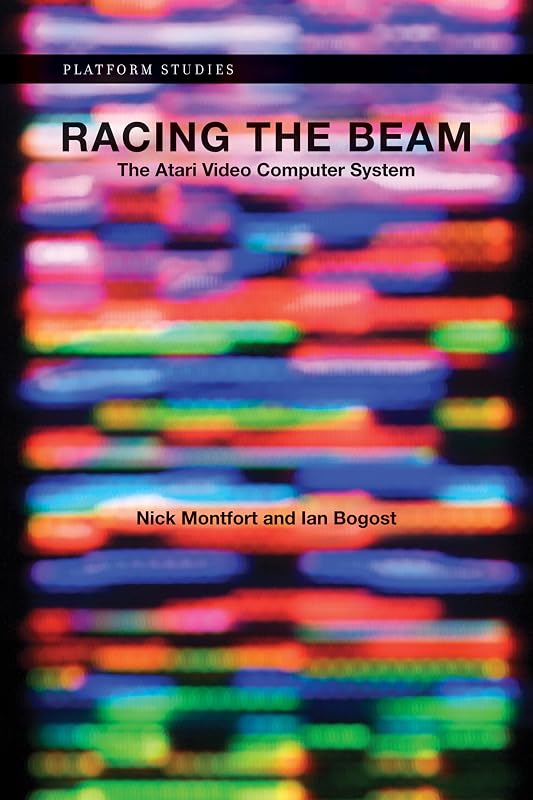
| Attribute | Detail |
|---|---|
| Publisher | The MIT Press |
| Publication Date | February 25, 2020 |
| Series | Platform Studies |
| Edition | Standard Edition |
| Print Length | 192 pages |
| Language | English |
| ISBN-10 | 0262539764 |
| ISBN-13 | 978-0262539760 |
| Item Weight | 8.4 ounces |
| Dimensions | 6.02 x 0.51 x 9.02 inches |
Technical Depth and Core Computing Concepts
The central achievement of this work is demystifying the internal engineering of the Atari VCS without alienating readers who lack a background in electrical engineering. At the core of the console sits the Television Interface Adaptor, a custom chip designed to generate an audiovisual signal directly for cathode-ray tube displays. Unlike modern systems that store complete visual frames in dedicated video memory, the VCS operated with only 128 bytes of RAM and zero frame buffer. The programmer had to write instructions in exact synchrony with the television electron gun as it swept across the phosphor screen line by line, creating the operational reality that inspired the book title.
In conducting this racing the beam technical analysis, the authors explain how physical circuitry directly dictated on-screen visuals. Montfort and Bogost unpack low-level microprocessor cycles and timing restrictions using structured descriptions and clear prose. Rather than treating code as abstract mathematics, they depict software routines as a live performance where every single microsecond of processor time must be accounted for before the television beam begins its horizontal blanking interval. This direct link between electronic physical properties and on-screen visuals demystifies how developers summoned colored sprites, playfield boundaries, and digital audio out of scarce silicon.
For readers intimidated by software architecture, the conceptual explanations remain grounded in recognizable visual outcomes. The authors do not require the reader to write 6502 assembly language to grasp the core concepts. Instead, the text introduces foundational terms, explains why the hardware lacked automated sprite positioning, and illustrates how engineers transformed computational limitations into deliberate gameplay features. The result is an accessible technical analysis that respects reader intelligence while keeping historical engineering concepts tethered to recognizable classic games.
Examination of Iconic Atari VCS Game Cartridges
To illustrate their central thesis, the authors organize the text around detailed teardowns of specific game cartridges that pushed the console in distinct directions. Rather than presenting a broad, shallow summary of the nearly one thousand cartridges produced for the system, this racing the beam summary demonstrates that depth yields far more insight than breadth. The book concentrates on six influential game cartridges, highlighting classic releases like Combat, Pac-Man, and Star Wars: The Empire Strikes Back, demonstrating how each title tackled hardware barriers to establish enduring mechanics and genres.
Combat, the launch title bundled with the system, serves as the baseline for demonstrating how the hardware was originally intended to function. Built around competitive tank battles and biplane dogfights, Combat directly mapped to the built-in hardware registers designed for two player sprites, two missile graphics, and a ball. By walking through Combat, the authors establish the baseline operational capabilities of the console before contrasting it with later titles that demanded far more from the limited circuitry. Today, enthusiasts can plug in dedicated modern hardware like the turtle beach velocity one racing wheel for precision input, but early VCS developers had to generate competitive vehicle interactions out of single-digit byte counts and rudimentary joysticks.
The examination of later cartridges proves equally compelling when analyzing the compromises of home ports and scrolling playfields. In the chapter focusing on Pac-Man, the racing the beam book breaks down the notorious sprite flickering that accompanied the home release, explaining the exact mathematical constraints that made drawing four distinct ghost sprites across shared scanlines impossible on the custom chip. Similarly, the study of Star Wars: The Empire Strikes Back showcases how programmers achieved multi-color horizontal scrolling on hardware never engineered to support moving backgrounds. Through these concrete case studies, historical programming feats become tangible hardware lessons.
Platform Studies and Creative Expression
Beyond raw electronics, this text stands as a foundational entry in the racing the beam platform studies series from The MIT Press. The platform studies discipline, pioneered in large part by Montfort and Bogost, posits that computational machines cannot be understood solely through cultural studies or purely through engineering documentation. Instead, meaningful comprehension requires studying the relationship between the underlying technical platform and the creative works developed for it. The Atari VCS dominated the home market so completely that the brand name became the generic label for video game consoles, yet its creative library was fundamentally tethered to its physical architecture.
The authors demonstrate that engineering boundaries did not simply restrict programmers; they actively inspired artistic and structural choices. When designers built playfields, animation routines, and scoring logic, they were collaborating directly with the physical components inside the console case. Modern sim racing enthusiasts might invest in a rigid gt lite racing cockpit to replicate true motorsport environments, but early Atari developers had to fire player imagination using solid-color geometric blocks and harsh square-wave audio tones. The text highlights how early designers embraced these severe constraints to invent conventions that still define interactive digital media today.
This rigorous approach separates the work from standard video game retrospectives that focus primarily on corporate mergers, boardroom feuds, and executive personalities. While business narratives offer historical value, racing the beam mit press redirects focus back to the cartridge ROM chips, circuit boards, and programming techniques. It treats the video game cartridge as a cultural artifact shaped by material conditions, providing readers with a durable critical lens for evaluating digital platforms across computing history.
Physical Presentation, Scope, and Format
Looking at the physical attributes of the publication reveals a volume structured for focused reading rather than unwieldy reference archiving. With an official racing the beam page count of 192 pages, the text remains concise and tightly edited. Published as a Standard Edition paperback measuring 6.02 by 0.51 by 9.02 inches and weighing 8.4 ounces, it provides a portable, ergonomic reading format that readers can easily finish across a few dedicated sessions without academic fatigue.
The interior layout supports the writing with helpful architectural diagrams, timing charts, and cartridge screenshots. Rather than serving as decorative visual filler, each figure corresponds directly to the technical subject under discussion, illustrating how electron scanlines align with register manipulation. For younger players who grew up playing colorful arcade racers using a hori nintendo switch mario kart racing wheel pro mini, seeing the raw technical anatomy of 1970s video generation provides a striking visual contrast. The clean typography and dependable binding reflect the high production standards associated with academic publishing.
Prospective readers should keep the specific scope of the text in mind before purchasing. Because the volume maintains a disciplined 192-page length, it intentionally limits its deep technical breakdowns to six featured game cartridges. The product listing notes that nearly a thousand cartridges were created for the platform, but this volume makes no attempt to catalog or evaluate every release. Readers looking for an all-inclusive collector field guide listing every rare cartridge variant will find this academic study too focused on hardware architecture to serve as an exhaustive directory.
Racing the Beam Pros and Cons
Pros
- Clear explanations of complex Atari hardware
- In-depth breakdowns of six iconic cartridges
- Concise 192-page length without academic fluff
- Pioneering approach linking hardware to game design
- High-quality standard edition printing by MIT Press
Cons
- Covers only six featured cartridges in detail
- Requires genuine curiosity about computer architecture
- Not an exhaustive collector directory
Check Racing the Beam on Amazon
Who Should Buy Racing the Beam
Deciding whether this title belongs on your bookshelf comes down to whether you want to explore the engineering logic behind retro gaming or simply enjoy casual nostalgic memories. It occupies a focused middle ground between accessible hardware history and scholarly media critique.
Buy It If
- You want to understand how early games generated visuals without video memory or a traditional frame buffer.
- You appreciate media history that examines how physical hardware constraints directly shaped creative game design.
- You prefer a concise, 192-page technical study that delivers substantive insights without unnecessary fluff.
- You want clear architectural explanations of famous titles like Combat, Pac-Man, and Star Wars: The Empire Strikes Back.
Skip It If
- You are looking for an exhaustive collector guide or visual catalog covering all one thousand VCS cartridges.
- You want a casual pop-culture memoir focused on corporate Silicon Valley boardroom drama.
- You dislike technical explanations involving timing cycles, memory limitations, and hardware registers.
Final Verdict
In this racing the beam review, the book proves to be an indispensable contribution to the study of digital media that remains welcoming to everyday retro enthusiasts. Nick Montfort and Ian Bogost successfully translate challenging computational principles—such as the missing frame buffer and the relentless timing demands of cathode-ray tube displays—into an engaging narrative of engineering creativity. By focusing on influential titles like Combat, Pac-Man, and Star Wars: The Empire Strikes Back, the text illustrates why understanding hardware constraints is vital to understanding early video game history.
For readers asking is racing the beam worth reading, the answer is an easy yes for anyone with a genuine curiosity about computing heritage. The volume treats cartridge development with serious intellectual care, offering a foundational introduction to platform analysis that permanently changes how you view retro software. While casual fans seeking nostalgic memorabilia might look elsewhere, racing the beam for retro gamers remains one of the most insightful and rewarding hardware studies available.
FAQ
What does the phrase racing the beam mean?
The phrase describes the central programming challenge on the Atari VCS. Because the console lacked video memory to hold a completed screen frame, developers had to write instructions that updated graphics registers in real time as the television electron beam swept across each horizontal scanline.
Do I need an engineering background to read this book?
No engineering or computer science degree is required to enjoy the book. While the text explores assembly concepts, memory boundaries, and microprocessor timing, the authors explain the architecture using clear language and visual diagrams so non-programmers can follow along.
How many games are covered in the book?
While the Atari VCS hosted nearly a thousand game cartridges over its commercial lifespan, the text focuses its in-depth analysis on six representative cartridges, including Combat, Pac-Man, and Star Wars: The Empire Strikes Back, to demonstrate specific programming solutions.
What are the physical dimensions and page count?
The Standard Edition paperback contains 192 pages, measures 6.02 by 0.51 by 9.02 inches, and weighs 8.4 ounces, making it a compact and easy-to-handle volume for casual reading.
What series does this book belong to?
This volume is part of the Platform Studies series published by The MIT Press, an academic initiative dedicated to examining the technical architecture of computing systems and their cultural impact.


