As Amazon Associates, we earn from qualifying purchases. This means we may receive a small commission at no extra cost to you if you click through and make a purchase.
The Thrustmaster TPR is a heavy-duty flight simulation accessory engineered to bring authentic, suspended pedal mechanics to desktop virtual aviators. Delivering fluid yaw movement through an overhead pendular design and contactless magnetic sensors, this standalone controller provides an uncompromising level of control for pilots who want exact aircraft behavior without the stickiness common to entry-level track systems.
This controller suits dedicated desktop aviators and simulator hobbyists who spend long hours navigating complex flight paths and need reliable, highly responsive directional control for precise landings. However, casual players with minimal desk room, console gamers, or those who need a light setup that packs away quickly into a drawer should look toward simpler, smaller alternatives.



Thrustmaster TPR at a Glance

| Feature | Specification |
|---|---|
| Compatible Platform | PC |
| Mechanism Type | Suspended pendular (Pendul_r technology) |
| Sensor Technology | H.E.A.R.T HallEffect magnetic sensors |
| Connectivity | USB wired |
| Product Weight | 20.2 pounds |
| Product Dimensions | 18.8 x 18 x 14.1 inches |
| Resistance Customization | Adjustable spring system (2 springs included) |
| Color | Black |
| Included In The Box | Instructions manual and flight pedals |
| Warranty | One year |
Suspended Pendul_r Mechanism and Realism
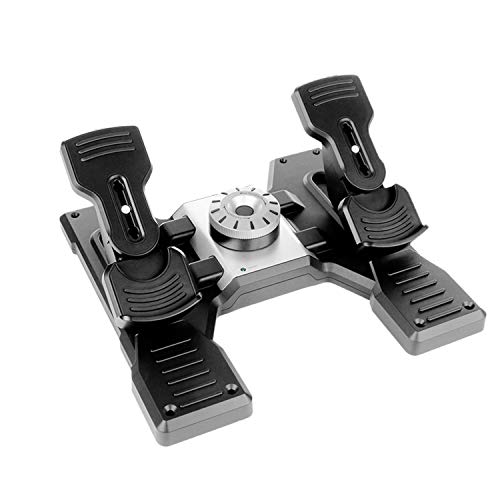
The defining element of the Thrustmaster TPR rudder pedals is the proprietary Pendul_r technology. Rather than relying on sliding rails that glide along a flat horizontal plane on the floor, the system utilizes a suspended mechanism anchored from above. As you push your feet forward, each pedal travels along a smooth, swinging arc. This suspended geometry closely mimics the natural kinetic travel found in real-world aircraft cockpits, allowing your feet and ankles to operate through an intuitive swing rather than a stiff forward push.
In virtual aviation, subtle directional corrections often determine whether an approach results in a centerline landing or a runway excursion. When using the Thrustmaster TPR pendular rudder, small foot pressures translate into immediate, continuous motion without initial friction or mechanical stiction. The movement remains balanced and natural whether you are flying gentle general aviation aircraft, navigating multi-engine airliners through stormy approaches, or holding a steady line during combat maneuvers.
Because the physical pivots swing from an overhead suspension frame, dirt, pet hair, and floor dust do not compromise the sliding tracks over time. Standard track-based pedals often accumulate debris in their greased grooves, resulting in uneven sliding and sudden jerky inputs. The overhead geometry of the TPR completely bypasses this issue, providing consistent mechanical travel throughout demanding, extended flight sessions.
H.E.A.R.T Magnetic Sensors and Flight Precision
Mechanical smoothness must be paired with accurate digital translation to be useful in a simulator. The Thrustmaster TPR rudder pedals specs detail the integration of H.E.A.R.T (HallEffect AccuRate Technology) magnetic sensors across the rudder axis. Instead of utilizing traditional potentiometers that measure physical friction along a conductive track, these sensors measure variations in magnetic fields without physical contact.
The primary advantage of Thrustmaster TPR Hall effect sensors is that frictionless operation maintains exact digital accuracy over years of regular use. Traditional potentiometers eventually develop dead zones, twitchy readings, and mechanical wear as the internal wipers degrade. Because magnetic sensors eliminate physical contact points, input fidelity remains completely identical from your first flight session to your hundredth cross-country journey, allowing pilots to execute surgical yaw corrections without sudden input jitter.
For pilots stepping up from entry-level integrated systems like the thrustmaster t.flight hotas x, the difference in fine directional control is immediately apparent. Micro-adjustments required to counteract crosswinds or correct slip during coordinated turns occur with razor-sharp feedback. The magnetic sensors detect minute pedal shifts, giving you total confidence when making tiny rudder adjustments just feet above the runway threshold.
Spring Adjustment and Resistance Customization
Pilots operate different aircraft categories, and each flight profile demands a specific pedal feel. The Thrustmaster TPR spring adjustment system provides physical fine-tuning via two included metal springs. These springs can be placed across multiple mounting positions on the chassis, allowing users to alter the overall return-to-center force and the mechanical resistance experienced underfoot.
Configuring the springs in high-tension positions delivers a firm, authoritative return that works exceptionally well for high-speed combat aircraft and aerobatics where positive centering is vital. Conversely, adjusting the springs to lighter tension positions provides a looser, highly sensitive throw suitable for light general aviation or multi-engine transport simulations. If you prefer minimal centering force, you can adjust the spring positions accordingly to achieve a featherlight response.
In addition to tension tuning, the unit features an ergonomic layout designed to accommodate varied foot sizes and seating postures. The pedal angles and physical positions offer enough room for your feet to rest comfortably over long journeys, helping prevent leg fatigue during three-hour navigation legs or extended flight training drills.
Chassis Footprint, Weight, and PC Compatibility
The physical presence of this controller is substantial. Weighing in at 20.2 pounds and measuring 18.8 by 18 by 14.1 inches, this is a massive piece of hardware. Its solid weight acts as an anchor on the floor, preventing the unit from sliding backward when you apply firm foot pressure. The black frame feels robust and rigid, providing a rock-solid foundation that does not flex or creak under aggressive yaw inputs.
However, that same 20.2-pound bulk means you need a dedicated location for it. This is not a compact accessory that you can easily unplug and tuck away behind a monitor between casual gaming sessions. Much like mounting heavy load cell gear on dedicated sim rigs, as seen in sim-racing hardware like the fanatec gran turismo dd pro, these rudder pedals perform at their best when placed in an open floor space or bolted directly into a flight cockpit frame.
Regarding system support, Thrustmaster TPR PC compatibility is strictly focused on computers. It connects via standard USB to PC platforms and integrates directly into desktop simulation titles. The product does not support game consoles, so desktop computer flyers are the sole intended audience. When setting up high-grade controls alongside accessories like the thrustmaster t flight hotas 4, ensuring you have an open USB port and sufficient legroom under your desk is essential.
Thrustmaster TPR Pros and Cons
Pros
- Suspended pendular motion mimics real aircraft rudder mechanics
- Contactless HallEffect magnetic sensors prevent mechanical wear
- Substantial 20.2-pound metal frame prevents unwanted sliding
- Adjustable spring system allows customized pedal resistance
- Frictionless overhead design avoids floor dust and rail stiction
- Ergonomic pedal design supports long flight sessions
Cons
- Large physical footprint requires significant floor space
- Heavy 20.2-pound chassis is difficult to stow away
- Compatible exclusively with PC systems
Check Thrustmaster TPR on Amazon
Who Should Buy the Thrustmaster TPR
Buy It If
- You want the realistic swinging motion of an overhead pendular suspension rather than sliding floor rails.
- You require contactless Hall effect magnetic sensors that eliminate input jitter and mechanical wear over time.
- You want an adjustable two-spring resistance system to customize pedal firmness for commercial, general aviation, or combat craft.
- You have a dedicated desktop flight cockpit or permanent floor area that can accommodate a 20.2-pound controller.
Skip It If
- You play flight simulation games exclusively on a gaming console, as this unit is built strictly for PC.
- You lack floor space under your desk and need lightweight hardware that can be quickly stowed in a closet.
- You prefer a simple plug-and-play desktop joystick with an integrated twist-rudder handle.
Thrustmaster TPR Alternatives Worth a Look
While the TPR stands out for its pendular build, evaluating other options on the market helps determine the best flight simulator rudder pedals for your personal setup, available floor space, and operational style.
Logitech G Pro Flight Rudder Pedals
The Self-centering mechanism Logitech G Pro Flight Rudder Pedals feature differential toe brakes, an adjustable tension dial, part-metal construction, and broad PC compatibility. In a direct comparison of the Thrustmaster TPR vs Logitech G Pro, the Logitech option utilizes a more conventional sliding axis and an integrated tension dial rather than an overhead suspended pendular frame. Simmers who want standard sliding action with an integrated tension dial in a smaller, part-metal package may prefer this alternative.

Honeycomb Aeronautical Charlie Rudder Pedals
The Honeycomb Aeronautical Charlie Rudder Pedals are PC-compatible pedals built for realistic and immersive flight experiences, featuring left and right toe brake axes along with adjustable feet angles. Pilots who already run matching civilian flight consoles and prioritize adjustable foot angles over an overhead pendular swing mechanism should consider the Charlie model.

WINCTRL Orion Metal Flight Rudder Pedals
The WINCTRL Orion Metal Flight Rudder Pedals (With Damper Edition) provide a full metal frame, a stainless steel center-return mechanism, quick-swap springs, three control modes, and Hall sensors. Aviators seeking a full-metal construction with integrated damping and multiple selectable control modes will find this a viable heavy-duty option.

Final Verdict
When assessing whether the Thrustmaster TPR for flight sim setups is an essential addition, the mechanical execution speaks for itself. The combination of suspended Pendul_r kinematics and frictionless H.E.A.R.T magnetic sensors solves the stiction, dead zone, and dust issues that plague standard sliding rail designs. It turns subtle foot movements into immediate, reliable yaw corrections that make crosswind touchdowns, formation flying, and precision taxiing feel remarkably genuine.
If you have the necessary room beneath your desk and fly exclusively on PC, the question of is Thrustmaster TPR worth it is met with a resounding yes for passionate virtual aviators. Its 20.2-pound build, customizable two-spring resistance, and durable frictionless tracking deliver a professional-grade simulation experience that will anchor your desktop cockpit for years of flight time.
FAQ
Does the Thrustmaster TPR work on game consoles?
No. The Thrustmaster TPR is designed exclusively for PC via a standard USB connection and is not compatible with gaming consoles.
What makes the Thrustmaster TPR pendular rudder different from sliding pedals?
Instead of sliding back and forth on greased floor rails that can gather dust and suffer from mechanical friction, the TPR uses an overhead suspended mechanism that swings through an arc, mirroring the motion of real aircraft pedals.
How do you adjust the rudder resistance on the Thrustmaster TPR?
The unit includes two physical springs that can be mounted across multiple anchor positions on the chassis, allowing you to increase or decrease resistance depending on whether you are flying airliners, general aviation, or combat aircraft.
What components come included in the box?
The retail package includes the Thrustmaster TPR flight pedals unit and the official instructions manual.
Do the magnetic sensors in the Thrustmaster TPR wear out over time?
No. Because H.E.A.R.T HallEffect sensors use magnetic fields rather than physical contact wipers, they operate without friction, preventing mechanical wear and maintaining input accuracy over extended use.