
As Amazon Associates, we earn from qualifying purchases. This means we may receive a small commission at no extra cost to you if you click through and make a purchase.
The NVIDIA DGX Spark Bundle is a dual-node computing package that brings enterprise-tier machine learning hardware directly to your desk in a compact, modular format. Powered by the Desktop GB10 Grace Blackwell Chip, each unit functions as a self-contained personal supercomputing node equipped with high-density unified memory and specialized tensor acceleration. Rather than renting remote cloud instances that rack up metered infrastructure fees every month, this two-unit setup provides predictable, high-throughput model execution on local hardware.
This dual-pack suits software engineers, AI researchers, and technical organizations that need to experiment, fine-tune, and run inference on large models without transmitting sensitive internal data across external networks. If you simply need a general-purpose desktop workstation for office productivity, everyday content creation, or casual PC gaming, this specialized system is not designed for your workload and you should look toward conventional desktop builds instead.
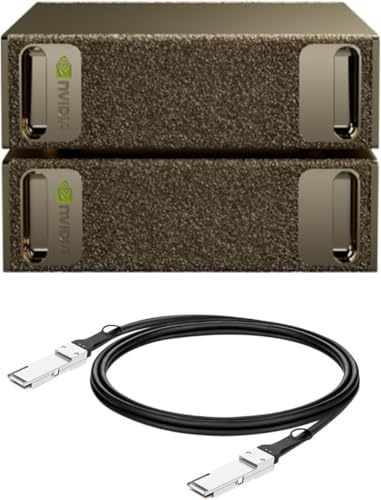


NVIDIA DGX Spark Bundle at a Glance

| Attribute | Detail |
|---|---|
| Processor Architecture | Cortex Series SoC (Desktop GB10 Grace Blackwell Chip) |
| Clock Speed | 3.8 GHz |
| AI Compute Output | Up to 1 petaFLOP AI Performance |
| System Memory | 128 GB Unified DDR5 per unit (128 GB maximum installed) |
| Internal Storage | 4 TB Solid State Drive (SSD) |
| Operating System | NVIDIA DGX OS |
| Form Factor | Mini PC (12 x 8 x 6 inches) |
| Unit Weight | 7 pounds |
| Display Output | HDMI |
| Included Peripherals | Interconnect cable bundle (listing notes No Plug for power) |
AI Performance and Grace Blackwell Architecture
At the center of the hardware lies the Desktop GB10 Grace Blackwell Chip, an integrated System on Chip (SoC) operating at a 3.8 GHz clock speed. NVIDIA rates this silicon at up to 1 petaFLOP of AI processing performance per unit. In practical terms, this specialized compute architecture gives developers the raw mathematical throughput needed to run deep learning inference, local fine-tuning routines, and complex data analytics right at their workstation. Because the architecture is built specifically for matrix multiplication and tensor math, it avoids the processing bottlenecks typical of general-purpose x86 processors attempting to handle heavy model weights.
The system is specifically engineered to handle large neural network weights locally, supporting models up to 200 billion parameters at FP4 precision. For engineering teams evaluating modern open-weight language models, multi-modal systems, or computer vision backbones, running FP4 quantization allows massive architectures to fit into hardware memory without dropping out of cache or relying on virtual swap space. This capability dramatically accelerates development cycles by eliminating the latency introduced when sending batches across remote network links.
When benchmarking sensor inputs or optical calibration data—whether sourced from industrial lenses or high-grade optical gear such as the nikon prostaff 3s 8×42—running raw data pipelines locally ensures uncompressed validation without bandwidth bottlenecks. The raw compute power of the Grace Blackwell chip lets you iterate on complex mathematical transformations and vector embeddings in real time, making the dgx spark bundle an effective development engine for rapid prototyping.
Unified Memory and Multi-Unit Scalability
Memory configuration is the deciding factor in whether a system can execute modern generative models, and the dgx spark unified memory design addresses this requirement directly. Each mini PC node in the bundle provides 128 GB of unified DDR5 system memory. Unlike traditional desktop PCs where the central processor and graphics card maintain separate pools of RAM linked across a bandwidth-constrained expansion slot, unified architecture allows the compute cores to access the entire 128 GB pool seamlessly. This unified structure removes memory duplication overhead and ensures large parameter sets remain immediately accessible.
The included cable bundle connects the two nodes into a cooperative pairing, effectively doubling your available physical resources across the desk. Having two interconnected nodes allows developers to partition tasks cleanly: you can dedicate one node to continuous inference or serving an internal endpoint, while using the second node to iterate on prompt pipelines, train low-rank adaptations (LoRAs), or process incoming analytics batches. This physical separation prevents development scripts from crashing active testing services.
For organizations questioning whether a dual-node purchase makes sense, the dgx spark 2 pack structure provides immediate operational redundancy. When testing deployment containers, you can validate clustering behavior and distributed model execution on your own desk before provisioning expensive data center capacity. The combined 256 GB aggregate unified memory across both machines accommodates extensive experimentation with massive quantized networks that would simply refuse to load on conventional hardware.
Hardware Form Factor and Connectivity
Despite delivering supercomputing-grade performance, each node adopts a remarkably compact mini PC profile. Measuring 12 x 8 x 6 inches and weighing just 7 pounds, the chassis occupies minimal desk space and can easily sit alongside existing monitors or tuck beneath a workstation riser. The compact footprint makes the dgx spark mini pc ideal for secure laboratory environments, private development offices, or edge deployments where server rack access is unavailable or prohibited by office space constraints.
Physical display connectivity is intentionally streamlined around an HDMI output interface. Because this machine is engineered primarily as a computational appliance rather than a multi-display media station, video output is meant for baseline system setup, console administration, or a primary display panel. Teams capturing visual telemetry often evaluate handheld imaging gear like the osmo pocket 4 pro to collect spatial video datasets before feeding them directly into local tensor engines through local network storage.
One critical detail buyers must plan for is the power supply configuration. The product listing states “No Plug” under the power plug type, indicating that regional electrical cables or specialized power cords may need to be supplied separately by the purchaser based on their facility’s electrical standard. Furthermore, the internal storage is anchored by a generous 4 TB solid state drive, providing ample local capacity for high-volume dataset caching, container images, and model checkpoint archives without requiring external drive attachments.
Software Stack and Operating System Integration
The hardware runs natively on NVIDIA DGX OS, an enterprise-grade Linux distribution specifically tuned to exploit the underlying Grace Blackwell hardware. DGX OS comes pre-configured with drivers, container runtimes, and low-level performance libraries required to execute the complete NVIDIA AI software stack. This out-of-the-box software integration saves days of tedious manual configuration, eliminating driver mismatches, CUDA version incompatibilities, and Linux kernel conflicts that routinely plague custom-built DIY workstations.
Because the environment mirrors the software stack used across large-scale enterprise clusters, any workflow developed on the local desktop can be transitioned straight into production. Engineers can prototype an end-to-end training or inference pipeline on the local machine, package it inside a standard container, and deploy it onto data center infrastructure without modifying code. The dgx spark grace blackwell synergy ensures that model optimizations implemented on your desk behave identically when scaled out.
Teams deploying autonomous agents, visual validation routines, or streaming media analyses—frequently testing pipeline inputs alongside mobile field rigs like the dji pocket 4 pro creator combo—will appreciate the stability of DGX OS. You spend your hours building models and refining hyper-parameters rather than troubleshooting operating system dependencies and display server quirks.
NVIDIA DGX Spark Bundle Pros and Cons
Pros
- Compact 12x8x6-inch mini PC desktop footprint
- 128GB unified memory per unit for 200B models
- Up to 1 petaFLOP Grace Blackwell AI performance
- Integrated 4TB fast solid state drive
- Pre-configured native NVIDIA DGX OS environment
- Dedicated interconnect cable included in two-pack
Cons
- Listing specifies no standard power plug included
- Single HDMI video interface limits display expansion
- Dedicated DGX OS unsuitable for general office gaming
Check NVIDIA DGX Spark Bundle on Amazon
Who Should Buy the NVIDIA DGX Spark Bundle
Buy It If
- You need to run or fine-tune models up to 200 billion parameters at FP4 without sending proprietary company data to cloud servers.
- You want a quiet, compact desktop supercomputer footprint instead of a loud, space-consuming server rack.
- Your workflow benefits from 128 GB of unified memory per unit combined with the full, pre-configured NVIDIA AI software stack.
- You require a two-node setup with an interconnect cable bundle to prototype distributed microservices and local inference clusters.
Skip It If
- You are seeking a general-purpose Windows desktop for everyday office tasks, standard gaming, or general video editing.
- You require multi-monitor display outputs directly from the chassis, as the unit is limited to a single HDMI output.
- You do not have the technical experience or infrastructure ready to configure a Linux-based DGX OS computational node.
NVIDIA DGX Spark Bundle Alternatives Worth a Look
If the specialized Grace Blackwell architecture or dedicated DGX OS environment does not align with your specific hardware preferences, several alternative compact workstations provide strong local processing capabilities.
MINISFORUM MS-S1 MAX Mini AI

The MINISFORUM MS-S1 MAX Mini AI is an AI workstation PC built around the AMD Ryzen AI Max+ 395 processor featuring 16 cores and 32 threads, paired with integrated RDNA3.5 graphics. It includes 128GB of fast LPDDR5x RAM, a 2TB SSD, dual M.2 PCIe 4.0 slots, a PCIe x16 slot, USB4 V2 (80Gbps), dual 10GbE networking, a 320W power supply, and Wi-Fi 7. Buyers who prefer an open x86 architecture with extensive standard peripheral expansion and 10GbE network connectivity should consider this machine over the proprietary DGX environment.
126 TOPS AI Workstation

The 126 TOPS AI Workstation is an AI desktop mini PC featuring the AMD Ryzen AI Max+ 395 chip paired with Radeon 8060S graphics, delivering 126 TOPS of computational throughput. It comes configured with 128GB LPDDR5 RAM, a 2TB NVMe SSD, dual USB4 ports, Wi-Fi 7, and support for up to four 8K displays. If your workflow demands extensive multi-display productivity alongside modern local neural processing, this system offers far superior display output flexibility compared to the single HDMI port on the DGX Spark.
Threadripper PRO 9995WX 96-Core AI

The Threadripper PRO 9995WX 96-Core AI is an uncompromising full-tower workstation packing a 96-core AMD Threadripper PRO 9995WX processor, three NVIDIA RTX PRO 6000 graphics cards with 96GB of memory, 768GB of system RAM, and 16TB of high-speed NVMe storage across four 4TB drives running Windows 11 Pro. Teams with massive budgets that need maximum raw compute, massive multi-GPU hardware capacity, and standard Windows application compatibility will find this heavy workstation far more capable for full-scale deep learning than a compact desktop mini PC.
Final Verdict
The NVIDIA DGX Spark Bundle delivers an exceptional concentration of machine learning performance into a physical footprint that sits comfortably on an office desk. By combining the Desktop GB10 Grace Blackwell Chip, 128 GB of unified memory per node, 4 TB of solid state storage, and a pre-configured DGX OS environment, this package eliminates the friction of building custom compute rigs while freeing teams from recurring cloud platform expenses. For running large quantized networks up to 200 billion parameters locally, the hardware proposition is coherent, capable, and practical.
However, prospective buyers must evaluate its dedicated nature before purchasing. With a single HDMI port, a Linux-based enterprise OS, and a listing that specifies no power plug included, this machine is strictly a specialized developer appliance rather than an all-around PC. If your goal is to secure proprietary data, prototype complex model pipelines, and run demanding local AI workloads without data center overhead, this two-node bundle is a powerful investment that delivers immediate desktop supercomputing utility.
FAQ
What operating system comes pre-installed on the DGX Spark?
The system comes with NVIDIA DGX OS pre-installed, an enterprise Linux operating environment specifically optimized to support the complete NVIDIA AI software stack and Grace Blackwell hardware drivers out of the box.
How much unified memory is included in the bundle?
The listing specifies 128 GB of DDR5 unified memory per unit, allowing developers to allocate substantial unified memory resources directly to large model weights and complex processing tasks.
Can the DGX Spark run models up to 200 billion parameters?
Yes, the hardware is designed to run models up to 200 billion parameters at FP4 precision directly on the desktop, enabling extensive local testing and iteration without cloud latency.
What display outputs are available on the physical unit?
The hardware interface features a single HDMI video output, intended primarily for direct system setup, local maintenance, and baseline display connectivity.
Does the package come with power cords included?
The product listing specifies “No Plug” under the power plug type details, meaning buyers should verify their regional power cord requirements and obtain compatible power cables for their setup.
How large is each unit in the DGX Spark bundle?
Each unit features a mini PC chassis measuring 12 x 8 x 6 inches and weighs approximately 7 pounds, making it compact enough to fit comfortably on standard office desks.


