
As Amazon Associates, we earn from qualifying purchases. This means we may receive a small commission at no extra cost to you if you click through and make a purchase.
The Nikon NIKKOR Z DX 16-50mm f/2.8 serves as a high-performance standard zoom lens built specifically for APS-C mirrorless cameras, bringing professional-tier wide-aperture optics into an everyday carry footprint. For creators working on cropped-sensor Z series camera bodies, finding a single walkaround lens that merges genuine low-light capability with a portable design has often meant choosing between bulky full-frame glass or slower variable-aperture kit lenses. This optic bridges that divide by delivering an expansive wide-angle to short telephoto range alongside a constant f/2.8 brightness that remains locked across the entire zoom travel. The bottom-line verdict is that this lens represents the ultimate everyday zoom for Nikon DX photographers who want uncompromising speed, dependable sharpness, and travel-ready dimensions in a single package.
This standard zoom is tailored directly for visual storytellers, documentary shooters, street photographers, and content creators who need clean indoor exposures, subject isolation, and reliable handheld stability. If you are upgrading from fixed-lens compacts like the nikon coolpix a900 to an interchangeable mirrorless body, this optic provides the light-gathering power and shallow depth of field required for advanced image making. However, photographers whose primary focus lies in distant birding, sideline athletics, or safari expeditions will find the 50mm maximum reach insufficient for extreme telephoto work, while full-frame FX shooters will need full-frame optics to avoid working in crop mode.
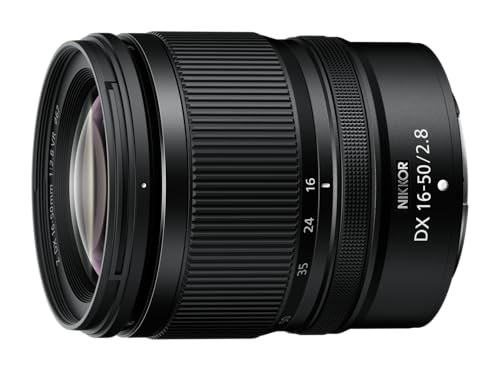


Nikon NIKKOR Z DX 16-50mm f/2.8 at a Glance

| Feature | Specification |
|---|---|
| Focal Length Range | 16 to 50 mm (24-75mm full-frame equivalent) |
| Maximum Aperture | f/2.8 (constant across entire zoom range) |
| Minimum Aperture | f/22 |
| Lens Mount | Nikon Z |
| Sensor Format | APS-C / DX format |
| Optical Image Stabilization | Vibration Reduction (up to 5 stops) |
| Diaphragm Blades | 9 rounded aperture blades |
| Physical Dimensions | 3.5 inches long |
| Weight | 11.6 oz (approx. 329 g) |
| Filter Size | 6.7 centimeters (67 mm) |
| Focus System | Auto and Manual focus support |
Aperture Speed and Low-Light Capability
The standout characteristic of this standard zoom is its constant f/2.8 maximum aperture, a major technical asset for creators wrestling with dim ambient environments. Standard kit lenses typically restrict their widest aperture as you zoom in, forcing you to shoot at f/5.6 or f/6.3 at the telephoto end. By maintaining f/2.8 from 16mm through 50mm, the lens allows you to preserve fast shutter speeds and lower camera ISO values when shooting inside dimly lit venues, during twilight city strolls, or in atmospheric interior setups. This constant brightness ensures consistent exposure values across your composition, saving you from constant metering adjustments while zooming in on a subject.
Beyond exposure control, the fast f/2.8 opening combined with nine rounded diaphragm blades yields superior background separation and circular out-of-focus highlights. For portraiture and detailed product closeups, having a wide physical entrance pupil makes it possible to render distracting background clutter into a soft, creamy wash. When shooting a subject at 50mm, the shallow depth of field helps portraits stand out with distinct optical depth that software-based digital blurring cannot fully emulate. The aperture stops down to f/22 when maximum depth of field is needed for front-to-back landscape sharpness, offering complete exposure flexibility across varying outdoor and studio conditions.
In challenging evening lighting, the nikon dx 50mm low light advantage becomes evident. Rather than relying entirely on camera sensor sensitivity or introducing tripod setups that slow down your pace, this nikon dx zoom constant f2.8 architecture allows you to capture candid moments cleanly. Whether you are photographing indoor gatherings, stage performances, or dimly illuminated urban scenes, the generous light intake minimizes noise and preserves fine micro-contrast in shadow areas.
Optical Vibration Reduction and Handheld Stability
Working handheld in marginal light requires more than just a wide aperture, and the built-in optical Vibration Reduction system addresses this necessity directly. Based on the CIPA 2024 standard, the integrated stabilization achieves up to 5 stops of shake correction when mounted to the Nikon Z50II at the telephoto end in NORMAL mode. This system counteracts the microscopic movements and natural hand tremors that cause image blur during slow shutter speeds, giving photographers the freedom to shoot in low-light environments without introducing heavy support gear.
For photographers who previously managed handheld shooting on bridge models such as the nikon coolpix b500, stepping up to the dedicated nikkor z dx 16-50mm f/2.8 vr system delivers noticeable refinement. The optical compensation keeps your viewfinder image steady, which assists with precise framing when tracking moving subjects or composing critical architectural lines. It also expands creative possibilities for handheld long exposures, allowing you to capture flowing water or light trails with sharp foreground details at shutter speeds that would otherwise require a rigid surface.
Videographers and run-and-gun documentarians also gain stability advantages from this optical stabilization. When recording dynamic b-roll or walking through an environment, the lens reduces jittery micro-shakes, producing cleaner, more professional footage straight from the camera. Because the optical element groups compensate for pitch and yaw movements inside the lens barrel, you achieve stable video recordings even on lightweight bodies that lack internal sensor-shift stabilization.
Focal Range Versatility from Wide Landscape to Portraiture
The 16mm to 50mm focal span provides a 3.13x zoom ratio that translates to an equivalent 24-75mm field of view in 35mm full-frame terms. This specific range has earned classic status in professional photography because it seamlessly covers wide-angle landscapes, street reportage, documentary scenes, and intimate portraiture without demanding lens swaps. At the 16mm wide end, the lens takes in expansive outdoor vistas, cramped room interiors, and grand architectural facades, offering wide perspectives with strong edge-to-edge definition.
As you rotate the zoom ring toward the 50mm setting, the field of view narrows to create a natural, flattering perspective suited for human subjects. When deployed as a nikon z50 portrait lens, the optic compresses facial features naturally without the wide-angle distortion that occurs when attempting portraits at shorter focal lengths. The combination of a 50mm focal perspective on a DX sensor with an f/2.8 aperture makes it a capable nikon 50 mm dx portrait tool, isolating subjects against smoothly rendered backgrounds while retaining sharp eye and hair textures.
This wide-to-normal versatility also extends into detailed closeup work and everyday documentary photography. From framing tabletop food arrangements to capturing spontaneous family gatherings, the focal progression covers the most frequently utilized visual angles. Photographers can transition instantly from an environmental wide shot that establishes a location to a tight framing of specific facial expressions or small textural details, maintaining visual consistency throughout a shoot.
Compact Ergonomics, Build, and System Compatibility
A persistent trade-off with constant f/2.8 standard zooms has traditionally been substantial bulk and front-heavy balance. However, the nikon z dx 16-50mm f2.8 avoids this pitfall by maintaining an exceptionally light weight of just 11.6 ounces (approximately 329 grams) and a physical length of only 3.5 inches. This compact profile preserves the inherent handling advantages of Nikon DX mirrorless cameras, ensuring that your overall kit remains balanced and unobtrusive during full days of travel or active street exploration.
The physical barrel features a standard 6.7 centimeter (67 mm) front filter thread, allowing you to mount circular polarizers, neutral density filters, or protective clear filters without needing custom filter rings. The optical design incorporates an auto/manual focus mechanism, providing seamless transitions between fast autofocus tracking and deliberate manual focus control. Every mechanical aspect is engineered to balance durability with effortless carry, fitting easily into compact messenger bags or jacket pockets.
In terms of camera pairing, the lens connects natively to the Nikon Z mount and is fully compatible with APS-C bodies including the Nikon Z 30, Nikon Z 50, and Nikon Z fc. It serves as an ideal nikon z fc walkaround lens, pairing vintage aesthetic camera bodies with contemporary optical performance without introducing awkward balance issues. For creators examining the published nikkor z dx 16-50mm f/2.8 specs, the balance of an 11.6 oz weight with a constant wide aperture makes it an easy recommendation for everyday field use.
Nikon NIKKOR Z DX 16-50mm f/2.8 Pros and Cons
Pros
- Constant f/2.8 aperture across zoom range
- Up to 5 stops of optical Vibration Reduction
- Weighs only 11.6 ounces for easy carry
- Nine rounded blades for smooth background blur
- Compact 3.5-inch overall barrel length
Cons
- Limited telephoto reach beyond 50mm
- Designed for DX crop sensors rather than FX
- Uses 6.7cm filter diameter
Check Nikon NIKKOR Z DX 16-50mm f/2.8 on Amazon
Who Should Buy the Nikon NIKKOR Z DX 16-50mm f/2.8
Buy It If
- You need a fast, constant f/2.8 aperture to capture clean images in low-light environments like events, concerts, and night cityscapes.
- You want a lightweight, everyday walkaround zoom that weighs only 11.6 ounces and measures 3.5 inches in length.
- You photograph portraits and environmental subjects on a Nikon Z 30, Z 50, or Z fc and desire creamy background separation with nine rounded aperture blades.
- You rely on handheld shooting and want up to 5 stops of optical Vibration Reduction to avoid carrying a tripod.
Skip It If
- You need extensive telephoto reach for distant wildlife, bird photography, or outdoor field athletics beyond 50mm.
- You shoot exclusively with full-frame Nikon FX cameras and require an optic that covers a 35mm image sensor without cropping.
- You only shoot in bright outdoor daylight where wide f/2.8 apertures and optical stabilization provide minimal everyday advantage.
Nikon NIKKOR Z DX 16-50mm f/2.8 Alternatives Worth a Look
When selecting a standard or specialized zoom optic, evaluating different mount requirements and focal priorities helps clarify what fits your personal workflow, much like evaluating optical gear across categories like the nikon monarch m5 10×50 binoculars.
Tamron 17-70mm f 2.8 Di

The Tamron 17-70mm f 2.8 Di is an APS-C standard zoom lens built specifically for Sony E-mount mirrorless cameras, featuring built-in Vibration Compensation (VC) and an RXD autofocus stepping motor. Photographers who shoot within the Sony mirrorless ecosystem or who desire a longer 70mm telephoto reach while retaining a constant f/2.8 aperture will find this optic a compelling alternative to standard Z-mount options.
Canon RF100-400mm F5.6-8 is USM

The Canon RF100-400mm F5.6-8 is USM is a lightweight telephoto zoom designed for Canon EOS R series mirrorless cameras, offering extensive telephoto reach with built-in optical image stabilization. Canon shooters who need significant magnification for wildlife, birds, and outdoor sports rather than a standard everyday walkaround zoom will prefer this telephoto lens for their kit.
Mirrorless Super-Telephoto Zoom Lens

The Mirrorless Super-Telephoto Zoom Lens, listed as the Canon RF100-500mm F4.5-7.1 L is USM, is an L-series professional super-telephoto optic crafted for Canon EOS R mirrorless cameras. Photographers who operate in the Canon system and demand professional weather-sealed telephoto range for distant nature and fast sports tracking should consider this super-telephoto option instead of standard normal-range lenses.
Final Verdict
Determining whether it is nikon dx 16-50mm f2.8 worth it ultimately comes down to your shooting priorities and need for low-light versatility. By unifying a constant f/2.8 aperture, up to 5 stops of optical Vibration Reduction, and a proven 24-75mm full-frame equivalent field of view into an 11.6-ounce barrel, this optic eliminates the traditional compromises of APS-C photography. It enables you to walk out the door with a single, highly capable lens ready to handle landscapes, documentary street scenes, handheld evening exposures, and flattering portraits.
For owners of Nikon Z 30, Z 50, and Z fc cameras seeking to upgrade beyond standard variable-aperture kit glass, this lens delivers a substantial improvement in creative control. The smooth background blur produced by its nine rounded aperture blades and the sharp rendering across the zoom range make it a premier choice for everyday photography. If you want a dependable standard zoom that handles challenging light with ease while keeping your camera bag light, this lens is well worth your investment.
FAQ
Which cameras are compatible with the Nikon NIKKOR Z DX 16-50mm f/2.8?
The lens connects natively to the Nikon Z mount and is designed for APS-C format Nikon DX mirrorless bodies, including the Nikon Z 30, Nikon Z 50, and Nikon Z fc. It can also be mounted to full-frame Nikon Z FX cameras, where the camera will automatically switch to DX crop mode.
How many stops of stabilization does the optical Vibration Reduction provide?
According to the product specifications based on CIPA 2024 standards, the built-in optical Vibration Reduction provides up to 5 stops of shake compensation. This measurement is achieved when the lens is attached to the Nikon Z50II at the telephoto end in NORMAL mode.
What filter size does this lens require?
The lens features a front filter thread measuring 6.7 centimeters (67 mm). This allows you to attach standard threaded circular polarizers, neutral density filters, and protective UV filters directly to the front barrel.
Can you switch between autofocus and manual focus on this lens?
Yes, the lens listing specifies an Auto/Manual focus design, allowing photographers to utilize automatic focus tracking or take direct control with manual adjustments depending on the scene.
Is the Nikon NIKKOR Z DX 16-50mm f/2.8 suitable for portrait photography?
Yes, at the 50mm telephoto end, the lens provides an ideal focal length for portraiture alongside a fast f/2.8 aperture and nine rounded diaphragm blades. This combination produces natural facial compression and smooth background blur that helps subjects stand out cleanly.


